
Best of Spotlights · 7 min read
Coffee is one of the most widely traded agricultural commodities on earth — not literally the second-most-traded commodity overall, a popular claim that’s actually a decades-old myth even coffee historians have publicly retracted, but still one of the most economically vital crops grown anywhere. Over 125 million people depend on it for their livelihoods. And for most of its history, the farmers doing the hardest work — growing, picking, and processing the beans — have captured almost none of the value. Coffee cooperatives are changing that. This is the story of how, and who is doing it best.
The Problem With Coffee
Before we talk about the solution, we need to understand the problem.
The conventional coffee supply chain is one of the most extractive in the world. A farmer in Ethiopia, Guatemala, or Colombia grows and harvests coffee cherries, which are processed and dried into green coffee beans on or near the farm. From there, those beans pass through local traders, regional exporters, international brokers, shipping companies, roasters, and retailers — each taking a cut — before the beans are finally roasted, ground, and brewed into the cup in your hands. By the time that happens, the farmer who grew the coffee may have received as little as 1% of the retail price.
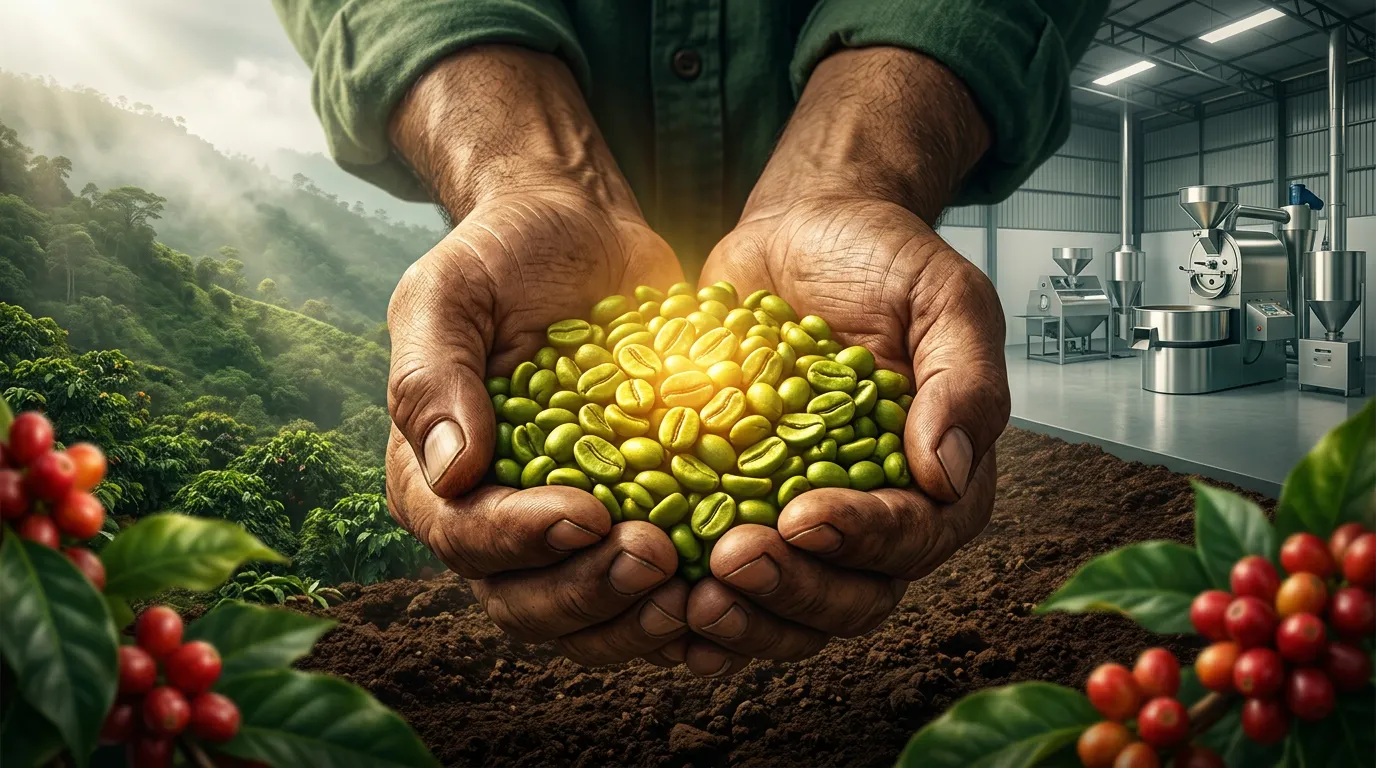
This isn’t an accident. It’s a structure. And it’s one that coffee cooperatives were specifically designed to dismantle.
What a Coffee Cooperative Does Differently
A coffee cooperative gives farmers collective ownership of the supply chain — or as much of it as possible. Instead of selling to a local trader at whatever price they can get, cooperative members:
- Pool their harvest to meet the volume requirements of international buyers
- Collectively own processing equipment — washing stations, drying beds, hulling machines — that individual farmers couldn’t afford alone
- Negotiate together for fair prices instead of competing against each other, gaining leverage against the exporters, roasters, and retailers who currently capture most of the value
- Keep the surplus with the people who grew the coffee, rather than letting it disappear into the margins of importers, roasters, and especially retailers further down the chain
- Invest in community — schools, healthcare, infrastructure — funded by cooperative premiums
The result, when done well, is transformational. Farmers who joined cooperatives in Ethiopia, Peru, and Nicaragua have seen their incomes double, triple, and in some cases quadruple compared to farmers selling through conventional channels.
The Best Coffee Cooperatives in the World
1. Oromia Coffee Farmers Cooperative Union — Ethiopia
The standout. The Oromia Coffee Farmers Cooperative Union (OCFCU) was founded in 1999 in the Oromia region of Ethiopia — the birthplace of coffee itself. It began with just 34 cooperatives, roughly 22,000 members, and $90,000 in capital. As of 2024, celebrating its 25th anniversary, it has grown to 413 member cooperatives representing over 562,000 farmers — including nearly 65,000 women.
The OCFCU story starts with one man: Tadesse Meskela, an agricultural bureau official who spent two months training in Japan, returned to Ethiopia with a vision for democratic cooperative organization, and built one of the most successful farmer-owned enterprises in the world.
What makes OCFCU exceptional:
- Returns roughly 70% of profits directly to member cooperatives (sources vary slightly on “gross” vs. “net” — the figure is consistently cited around 70%, but the exact basis differs by source)
- Bypasses middlemen entirely — sorting, roasting, and exporting its own coffee, rather than simply growing and picking it the way most other Ethiopian coffee farmers do
- Built its own bank — OCFCU is the largest shareholder in the Cooperative Bank of Oromia, which it co-founded in 2006
- Invested cooperative premiums in 15 schools and 42 classrooms for farming communities
- Featured in the 2006 documentary Black Gold
2. Pachamama Coffee — Global
Pachamama Coffee is one of the only truly farmer-owned coffee brands available in U.S. retail — owned entirely by a cooperative of smallholder farmers from Peru, Nicaragua, Guatemala, Mexico, and Ethiopia. There are no outside investors. No corporate parent. The farmers who grow the coffee own the company that sells it.
3. Equal Exchange — USA
Equal Exchange is the pioneering worker-owned cooperative that helped introduce fair trade coffee to the United States. Founded in 1986, it sources exclusively from small farmer cooperatives and operates its U.S. roasting and distribution business as a democratically governed worker cooperative. Equal Exchange doesn’t just buy from cooperatives — it is one.
4. Sidama Coffee Farmers Cooperative Union — Ethiopia
The Sidama Coffee Farmers Cooperative Union represents tens of thousands of farmers in southern Ethiopia’s Sidama region — home to some of the most celebrated specialty coffees in the world, including the legendary Yirgacheffe. Like OCFCU, Sidama has built its own processing infrastructure and negotiates directly with international specialty roasters.
5. COOPEDOTA — Costa Rica
COOPEDOTA is a Costa Rican coffee cooperative founded in 1960 that became the world’s first carbon-neutral coffee cooperative, certified by the British Standards Institution in 2011. Its 900 farmer-members collectively own all processing and export infrastructure. COOPEDOTA proves that cooperative ownership and environmental leadership are not in tension — they reinforce each other.
Want more stories like this in your inbox?
New posts every week on cooperative economics, worker ownership, and the solidarity economy in action. No spam — ever.
Subscribe at solidarityecono.my →
What the Best Coffee Cooperatives Have in Common
- Democratic ownership — farmers vote on decisions, not investors
- Surplus returned to members — profits stay with the people who created them
- Collective infrastructure — shared processing, shared export capacity, shared bargaining power
- Community reinvestment — cooperative premiums fund schools, healthcare, and local development
- Vertical integration — the best cooperatives don’t just grow coffee, they process, brand, and export it too
The Fair Trade Connection
Most of the world’s best coffee cooperatives are Fair Trade certified — a designation that guarantees minimum prices, social premiums, and democratic governance standards. Fair Trade is not perfect, and it has faced legitimate criticism for setting floors that are still too low.
But here’s what the data shows: farmers in Fair Trade certified cooperatives consistently earn more, have better access to credit, and invest more in their children’s education than comparable farmers selling through conventional channels.
“What I noticed was 95 percent, and above, do not know where coffee comes from. They don’t know the life of the person behind the cup.” — Tadesse Meskela, general manager, Oromia Coffee Farmers Cooperative Union. Source: Oxfam America
Why This Matters Beyond Coffee
Coffee cooperatives are not just a story about coffee. They are a proof of concept for cooperative economics in global commodity supply chains — one of the most challenging environments imaginable for worker ownership.
If cooperative ownership can work in coffee — where farmers are scattered across remote highlands, where commodity prices fluctuate wildly, where global corporations control distribution — it can work anywhere.
The OCFCU didn’t just build a better coffee company. It built a bank, a school system, and a democratic institution that represents over 100,000 farmers in one of the poorest regions on earth.
That is what cooperative economics looks like at its best. Not a niche. Not a charity. A competitive, democratic, community-owned enterprise that outperforms the extractive alternative on every measure that matters.
Keep Going
- 🌐 Be part of it — solidarityecono.my
- 📋 Get involved — fill out our intake form
- 🛒 Shop at our Marketplace — solidarityecono.my
This is part of our Best of Spotlights series — shining a light on the cooperative businesses and projects building the new economy. Know a cooperative we should feature? Reach out through solidarityecono.my.
Written by the Cooperative Codebase team — Aaron, Israel, and Jamie. Part of the Solidarity Economy Marketplace. Last updated: July 2026.
Comments