Best of Spotlights · 7 min read
In 1986, three friends working at a food co-op in Boston decided to do something that everyone told them was impossible. They were going to import coffee directly from small farmer cooperatives in Latin America, pay fair prices, and sell it in American grocery stores — as a worker-owned cooperative. No outside investors calling the shots. No exploitation of farmers. No compromises on either end of the supply chain. A more equal exchange. Forty years later, that vision is still standing — and still growing.
1986 — Equal Exchange founded in West Bridgewater, Massachusetts · 120+ worker-owners · $80M traded annually with farmer cooperatives worldwide · 2026 — merger with La Siembra creates first international worker cooperative
The Origin Story: Coffee, Solidarity, and an Embargo
Equal Exchange was founded in 1986 by Rink Dickinson, Jonathan Rosenthal, and Michael Rozyne — three colleagues who met while working at Northeast Coops, a Boston-area food distributor owned by grocery cooperatives.
The founders were looking to empower farmers at the bottom of the global food system, paying those farmers higher prices while still being viable in the marketplace. They dreamed of creating a more transparent and vital connection between farmers and consumers — a more equal exchange.
Their first act was audacious — importing fairly-traded coffee from Nicaragua in 1986, despite a U.S. embargo against the Sandinista government. This was not just a business decision. It was a political act of solidarity. When the Office of Foreign Assets Control threatened to close the legal loophole they used in 1988, Equal Exchange’s founders launched a campaign against the move — and won. Equal Exchange had announced itself to the world.
Equal Exchange’s founders weren’t acting in isolation — they were part of a much broader wave of Central America solidarity organizing in the 1980s. The Democratic Socialists of America was deeply involved in that same movement, opposing the Reagan administration’s policies in Nicaragua and El Salvador in direct solidarity with the Sandinistas and leftist rebels.
The Model: Cooperative All the Way Down
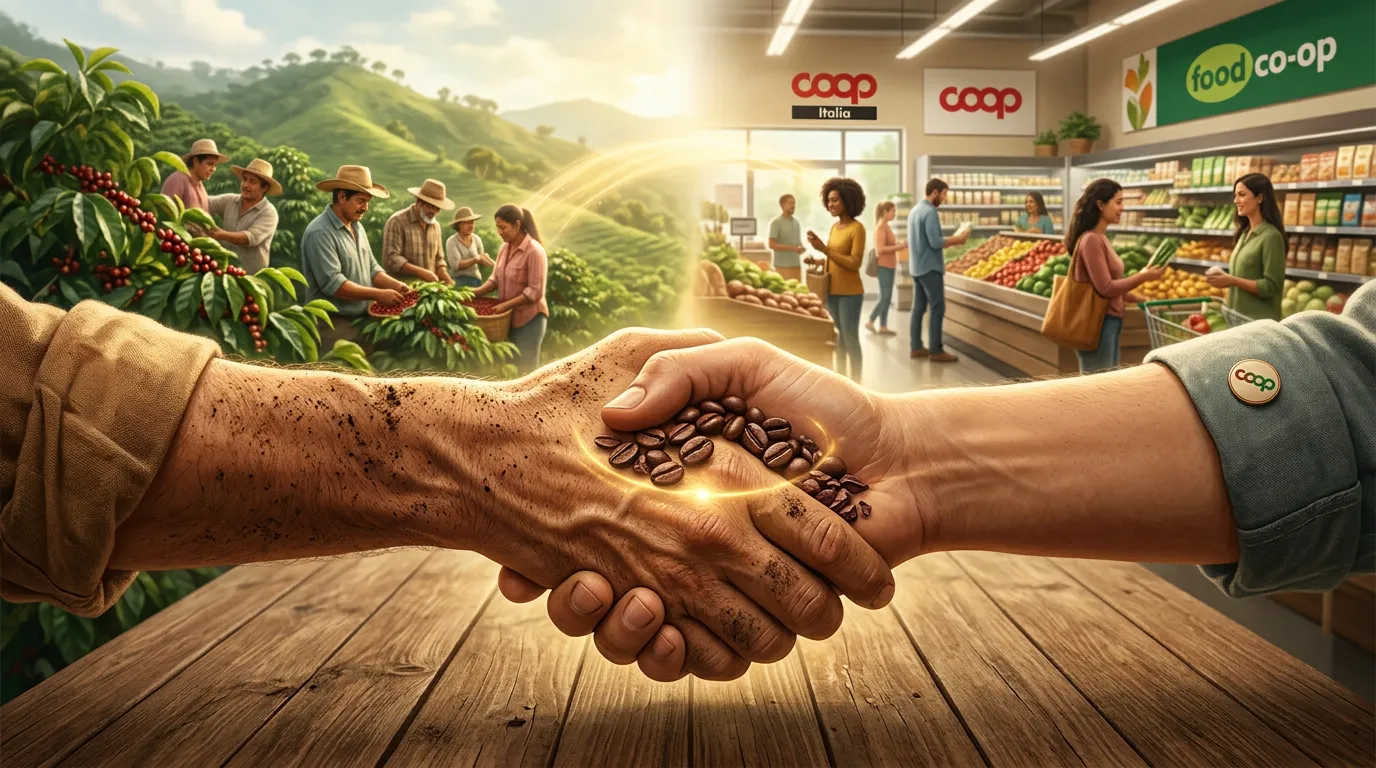
What makes Equal Exchange genuinely distinctive is not just that it trades fairly with farmer cooperatives. It’s that it is itself a cooperative — governed by the same democratic principles it demands from its supply chain partners.
When Equal Exchange was founded, it was designed to be worker-owned, to mirror the structures of the farmer-owned cooperatives they were working with.
All worker-owners own an identical share of Equal Exchange and receive an equal share of profits and losses. Worker-owners have an equal vote in electing the Board of Directors, six of whom are worker-owners themselves. The Board oversees hiring the executive team — who are also worker-owners — creating a circle of democracy that ensures everyone is accountable to one another.
How Worker Ownership Works at Equal Exchange
- New employees spend their first year learning the business with an assigned mentor and completing “exchange time” — a curriculum covering cooperative history and Equal Exchange’s mission
- After one year, workers are eligible to apply for ownership — requiring approval by at least 80% of current worker-owners
- Worker-owners receive equal profit shares, equal voting rights, and equal accountability
- When leaving, worker-owners sell their share back at the same price they paid — preventing speculative appreciation and keeping ownership accessible to future workers
The Farmer Partnerships: Cooperative to Cooperative
Equal Exchange works exclusively with small farmer cooperatives — not large plantations, not individual farms, not corporate suppliers. Its partners include Asprocafe Ingruma in Colombia, CACVRA in Peru, COOPAC in El Salvador, and cooperatives in Guatemala, Nicaragua, Ethiopia, and beyond.
Equal Exchange pays prices that ensure farmers can cover their costs, invest in their communities, and build sustainable livelihoods — not just the minimum Fair Trade floor price, but often significantly above it, based on long-term relationships rather than spot market transactions.
This is cooperative to cooperative trade — the solidarity economy operating across international borders.
Want more stories like this in your inbox?
New posts every week on cooperative economics, worker ownership, and the solidarity economy in action. No spam — ever.
Subscribe at solidarityecono.my →
The Products: Beyond Coffee
Equal Exchange started with coffee and expanded into a full range of fair trade products — all sourced from small farmer cooperatives:
- Coffee — sourced from cooperatives across Latin America, Africa, and Asia
- Chocolate and cacao — from cooperatives in Peru, Ecuador, the Dominican Republic, and West Africa
- Tea — from farmer cooperatives in Sri Lanka, India, and South Africa
- Bananas and avocados — from cooperatives in Ecuador and Mexico
- Olive oil — from cooperative producers in Palestine, a long-standing solidarity partnership
- Nuts, dried fruit, and sugar — all fair trade, all small-farmer cooperative sourced
Equal Exchange now has 120+ worker-owners fairly trading $80M annually.
The 2026 Milestone: Merging With La Siembra
The biggest news of Equal Exchange’s 40th anniversary year is its merger with La Siembra — the Canadian fair trade worker cooperative. As of January 1, 2026, Equal Exchange fully merged with La Siembra and transitioned Canadian member ownership to worker-owner shares in Equal Exchange, creating a global worker-owned cooperative across borders.
This is a first. A genuinely international worker cooperative — with worker-owners in both the United States and Canada, governed democratically across borders, trading fairly with farmer cooperatives across the globe.
The cooperative economy just went international.
The Citizen Consumer Model
Equal Exchange has built an entire network of “Small Groups” — faith communities, schools, workplaces, and community organizations — that collectively purchase Equal Exchange products and serve as ambassadors for the cooperative model.
These small groups are the retail end of the cooperative supply chain — organized, conscious consumers who understand that every purchase is a vote for a different kind of economy.
“At the end of the day, if we’re not cooperating, it’s not going to work. Equal Exchange is doing the work, and Seward Co-op has often been there to say ‘yes’ to the work.” — River Cook (they/them), worker-owner at Equal Exchange
What Equal Exchange Proves
- You can pay farmers fairly and still compete in mainstream retail — Equal Exchange products are on the shelves of Whole Foods, independent grocery cooperatives, and thousands of other retailers across North America
- Worker ownership scales — Equal Exchange has grown every decade for 40 years as a worker cooperative
- The supply chain can be cooperative end-to-end — from farmer cooperative to worker cooperative to consumer cooperative
- International worker cooperation is possible — the 2026 merger with La Siembra proves worker ownership can cross national borders
- Forty years is proof — Equal Exchange has been profitable 24 out of 25 years as a cooperative
Keep Going
- 🌐 Be part of it — solidarityecono.my
- 📋 Get involved — fill out our intake form
- 🛒 Shop at our Marketplace — solidarityecono.my
This is part of our Best of Spotlights series — shining a light on the cooperative businesses and projects building the new economy. Know a cooperative we should feature? Reach out through solidarityecono.my.
Written by the Cooperative Codebase team — Aaron, Israel, and Jamie. Part of the Solidarity Economy Marketplace. Last updated: July 2026.
Comments