
History Bites · 8 min read
In December 2001, Argentina’s economy collapsed. Banks froze deposits in an emergency measure called the corralito — the little corral — trapping the savings of millions of ordinary Argentines. The peso lost two-thirds of its value. Unemployment hit 25%. Five presidents resigned in two weeks. And in the rubble of neoliberalism’s most spectacular failure, Argentine workers did something remarkable: they occupied their factories, kicked out the owners, and ran them themselves.
2001 — Argentina’s economic collapse triggers the cooperative revolution · 200+ fábricas recuperadas at peak · 15,000+ workers in recovered factory cooperatives
The Corralito: When the Economy Stopped
Argentina had spent the 1990s as the poster child of IMF-mandated neoliberal reform — privatization, deregulation, currency pegged to the U.S. dollar, austerity. The IMF praised Argentina’s “reforms” as a model for the developing world.
Then it fell apart. Foreign debt became unpayable. Capital fled. On December 1, 2001, bank accounts were frozen. Argentines could not withdraw their own savings.
The response was immediate and furious. “¡Que se vayan todos!” — “Out with all of them!” — became the chant in the streets. Five presidents came and went in ten days. The country defaulted on $100 billion in debt — the largest sovereign default in history at the time.
And then, as the formal economy lay in ruins, Argentines started building something new.
The Barter Networks: A Parallel Economy
As the peso collapsed and cash became scarce, Argentines invented their own currencies. By 2002, an estimated 6 million people were participating in barter clubs across Argentina — trading food, services, clothing, and goods using locally issued créditos instead of pesos.
The Red Global del Trueque had started modestly in 1995 in a Buenos Aires suburb. By 2002, at the peak of the crisis, it had grown into one of the largest alternative currency networks in history — with thousands of nodes across the country, each issuing its own local currency backed by the labor and goods of its members.
This wasn’t just survival economics. It was cooperative economics in its most spontaneous and grassroots form.
Ocupar, Resistir, Producir: The Recovered Factories
As Argentina’s crisis deepened, factory owners began closing their businesses — sometimes abandoning them entirely, sometimes stripping them of equipment and fleeing in the night. Workers arrived at their jobs to find the doors locked and their livelihoods gone.
Their response became a movement. The slogan was simple and radical: “Ocupar, Resistir, Producir.” Occupy. Resist. Produce.
Workers occupied their factories. They refused to leave. They restarted production under their own management. And they organized themselves as worker cooperatives — electing councils, setting wages collectively, making decisions democratically.
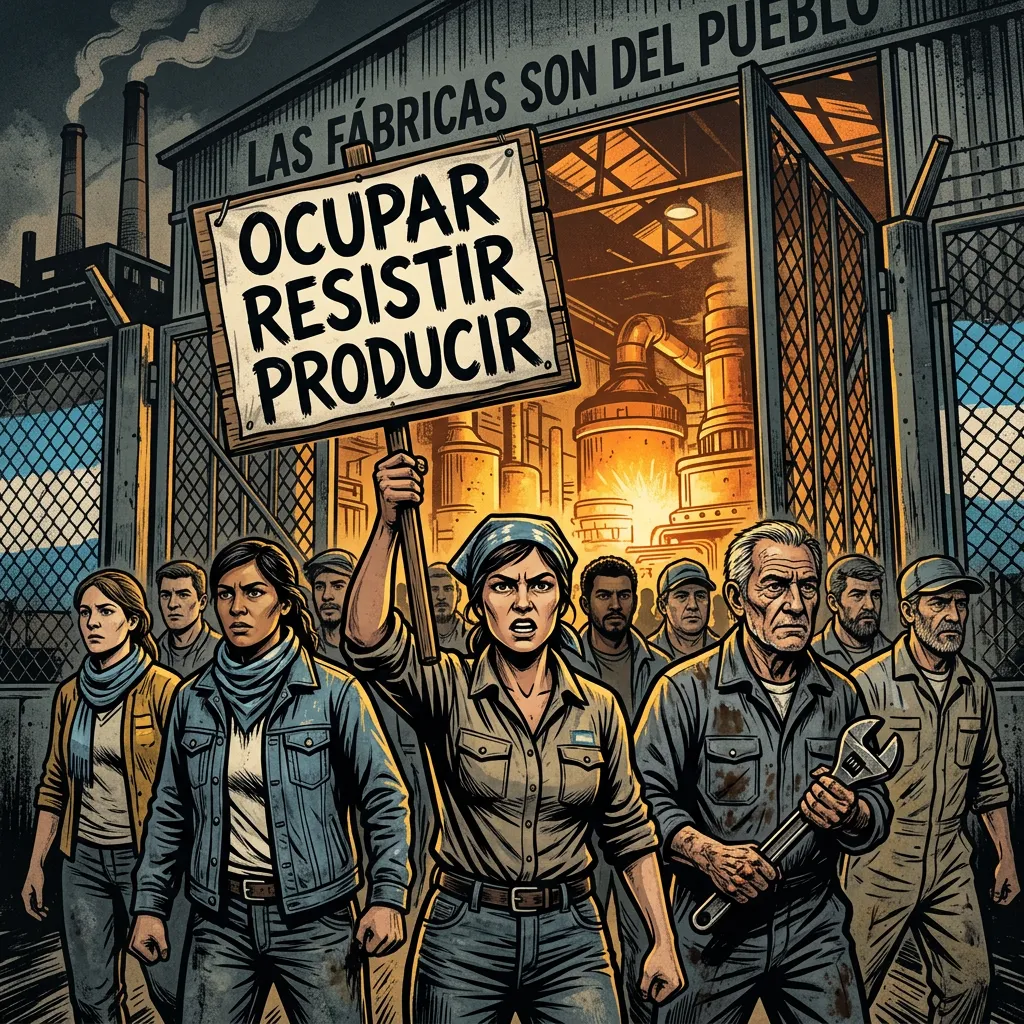
“Las Fábricas Son Del Pueblo.” The factories belong to the people.
The Famous Case
Zanón — The Ceramic Factory. FaSinPat (Fábrica Sin Patrones — Factory Without Bosses) was the most celebrated of the recovered factories. The Zanón ceramic tile factory in Neuquén was occupied by its 470 workers in 2001 after the owner abandoned it amid massive debt. Under worker control, production actually increased — from 15,000 to over 400,000 square meters a month at its peak. FaSinPat is still operating today as a worker cooperative — over two decades later — though its workforce has shrunk considerably, down to roughly 150 active workers as of 2024 amid broader pressure on Argentina’s ceramics sector.
Sources: FaSinPat — Wikipedia · Argentine Factory Wins Legal Battle — Upside Down World
The Legal Battle: Worker Ownership vs. Corporate Law
When workers occupied factories, they were technically trespassing on private property. Owners sought court orders for eviction. Workers faced police violence. Some occupations were cleared by force.
But the workers fought back. By 2004, Argentina had passed legislation in several provinces explicitly authorizing expropriation of abandoned enterprises for worker cooperative operation.
This was new legal territory — and it was being written by workers in occupied factories, not by lawyers in corporate boardrooms.
Want more history like this in your inbox?
New posts every week on cooperative economics, solidarity economy history, and the movements building a better world. No spam — ever.
Subscribe at solidarityecono.my →
The Cooperative Ecosystem: Beyond the Factories
The Argentine response to the corralito included a full cooperative ecosystem — cooperative bakeries trading with local currency, community gardens, sewing workshops, housing cooperatives, community health organizations, and barter networks connecting it all.
This is what the solidarity economy looks like in practice — not just individual enterprises but an interlocking ecosystem of cooperative institutions covering food, housing, health, work, and exchange.
What Argentina Proved
- Workers can run complex industrial enterprises without bosses — FaSinPat and hundreds of other recovered factories demonstrated this conclusively
- Communities can create functional alternative currencies — the barter networks showed that money is a social agreement, not a natural fact
- Crisis is an opportunity — the cooperative movement didn’t just survive the collapse, in many ways it flourished in it
- Legal systems can be changed from below — worker occupations forced changes in Argentine cooperative and expropriation law
- The cooperative form is resilient — many of the fábricas recuperadas are still operating today, more than two decades after the crisis
“The workers took on responsibility when the country was in full crisis and unemployment over 20 percent, where workers couldn’t find work. The workers formed a cooperative and created jobs, when no one believed that it was possible.” — Gabriel Quevedo, president of the Hotel Bauen workers’ cooperative
🔗 Worker Self-management Threatened at the Hotel Bauen in Buenos Aires — Grassroots Economic Organizing
The Legacy
Argentina’s fábricas recuperadas movement inspired cooperative movements globally. The 2004 documentary The Take, by Naomi Klein and Avi Lewis, brought the story to international audiences.
The movement also influenced Greece’s cooperative movement during the 2010s debt crisis — most directly through Vio.Me, a Thessaloniki factory whose workers directly invited Argentine recuperated-factory organizers to Greece to share their experience before Vio.Me’s own 2013 occupation — as well as the theoretical development of worker cooperative law in multiple countries, and the global solidarity economy movement worldwide.
Argentina’s crisis was capitalism’s failure. The cooperative response was humanity’s proof of concept.
Keep Going
- 🌐 Be part of it — solidarityecono.my
- 📋 Get involved — fill out our intake form
- 🛒 Shop at our Marketplace — solidarityecono.my
This is part of our History Bites series — bite-sized stories from the history of cooperative and solidarity economics. Want more? Join the Solidarity Economy platform and be part of building it.
Written by the Cooperative Codebase team — Aaron, Israel, and Jamie. Part of the Solidarity Economy Marketplace. Last updated: July 2026.
Comments