
History Bites · 8 min read
On January 1, 1994, the day NAFTA took effect, something extraordinary happened in the jungle highlands of Chiapas, Mexico. Thousands of indigenous Maya farmers — many wearing black ski masks, carrying machetes and old rifles — emerged from the jungle and seized the city of San Cristóbal de las Casas. They called themselves the Ejército Zapatista de Liberación Nacional. They declared war on the Mexican government. And then, over the next three decades, they built one of the most remarkable cooperative economies in the world.
1994 — Zapatista uprising begins on the day NAFTA takes effect · 1993 — the Women’s Revolutionary Law passed unanimously · 30+ years of building cooperative democracy outside the state
“No One Can Stop Us Now”
The Zapatistas had captured the imagination of a generation — not just in Mexico, but globally. Their uprising, launched on January 1, 1994 — the same day NAFTA took effect — was widely described as one of the first major revolts against neoliberal globalization, a timing the Zapatistas chose deliberately. Their spokesperson, Subcomandante Marcos, wrote communiqués that blended poetry, philosophy, and political theory, building a global following. They inspired movements on every continent, through transnational solidarity networks and gatherings the Zapatistas called encuentros.
But the Zapatistas weren’t just a symbol. They were building something real. And three decades later, that something is still standing — cooperatively owned, democratically governed, and quietly proving that another world is not just possible but already here.
Why They Rose Up: NAFTA and the Destruction of the Ejido
To understand the Zapatistas you have to understand what NAFTA did to Mexican farming communities.
The North American Free Trade Agreement took effect on January 1, 1994. As part of the conditions for NAFTA, the Mexican government had reformed Article 27 of the Constitution the previous year — effectively ending the legal protection of ejido communal lands and opening them to privatization and sale.
For indigenous communities in Chiapas, this was not an abstract policy change. It was the legalization of their dispossession. The ejido lands that communities had farmed collectively for generations — protected since the revolution — could now be sold out from under them.
“Tierra y Libertad” — the revolutionary cry of 1910 — became the revolutionary cry of 1994.
The Caracoles: Building Autonomous Cooperative Communities
After the initial uprising and the subsequent ceasefire, the Zapatistas did something that surprised the world. They stopped trying to take state power and started building their own.
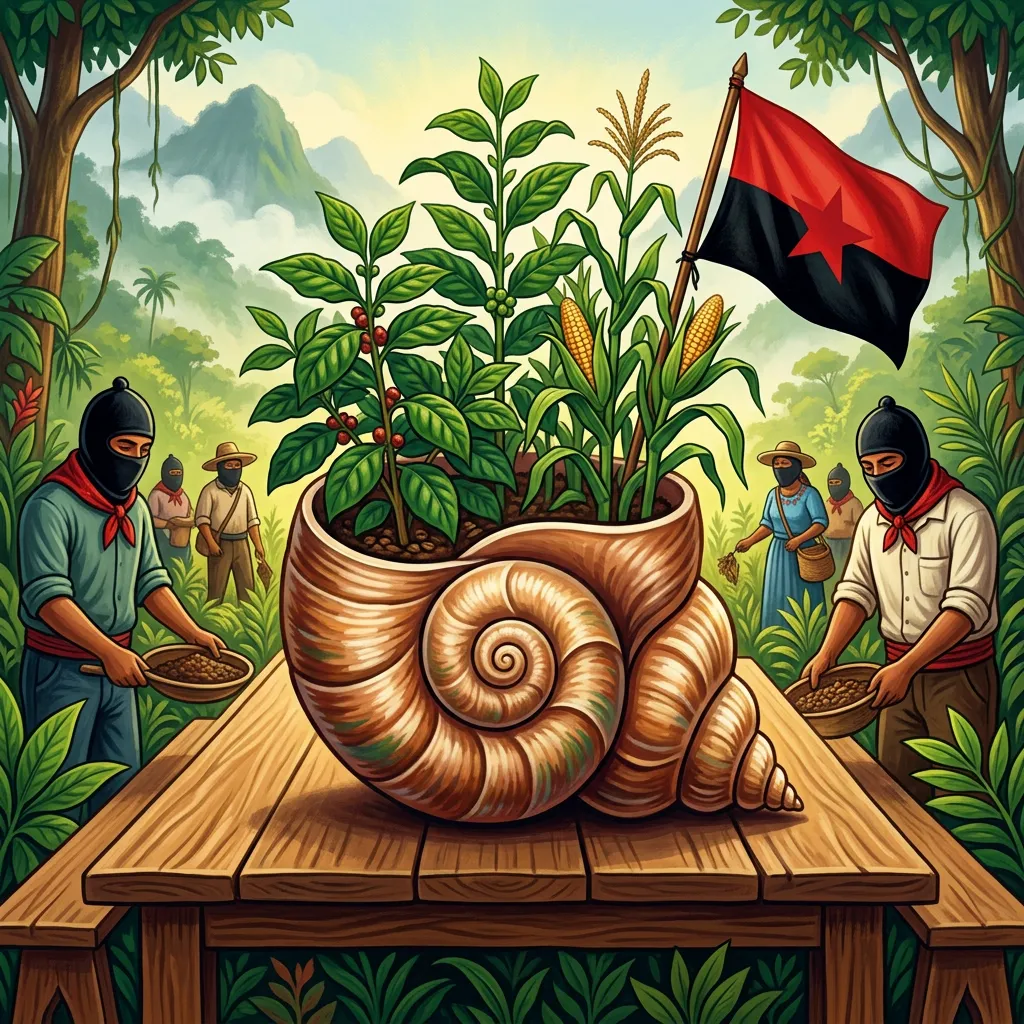
In 2003, the EZLN established five autonomous regions in Chiapas, each centered on a caracol — a spiral shell, symbol of slow and steady movement. From 2003 to 2023, each caracol was governed by a Junta de Buen Gobierno — a Council of Good Government — made up of rotating community representatives who served without pay and could be recalled at any time by the communities they represented.
In November 2023, citing escalating cartel violence and displacement across Chiapas, the EZLN dissolved the Juntas de Buen Gobierno and the Rebel Zapatista Autonomous Municipalities (MAREZ) they governed. In their place, the Zapatistas built a more decentralized structure: hundreds of Local Autonomous Governments (Gobiernos Autónomos Locales, or GAL) — one per community — that answer directly to their own local assembly, convening as needed into regional Collectives of Zapatista Autonomous Governments (CGAZ) and, above those, mobile coordinating assemblies (ACGAZ) with no independent authority of their own. Where twelve Juntas de Buen Gobierno once existed, hundreds of GALs now do. The caracoles themselves remain, but oriented inward — toward their own communities first.
The Coffee Cooperatives: An Economy Built on Solidarity Trade
Chiapas produces roughly a quarter of Mexico’s coffee, and coffee has been the economic backbone of Zapatista autonomy since the beginning.
Mut-Vitz — “The Mountain of Birds” — was the first coffee cooperative made up exclusively of Zapatista members, founded in 1997 with 200 producers. By 1999 it was exporting directly to Europe and the U.S., paid at fair-trade prices — more than double what intermediaries had offered. Within three years, exports had grown fivefold. The cooperative was forcibly dissolved by the government of Chiapas in 2009, officially over tax irregularities.
Other Zapatista coffee cooperatives took its place and grew alongside it: Yachil Xojobal Chulchan (“The New Light of the Sky”), founded in 2001 by producers not yet accepted into Mut-Vitz, and Yochin Tayel Kinal (“Starting to Work the New Land”), based in Altamirano. All three achieved organic certification; later cooperatives, facing the cost of formal certification, developed their own “self-certification” systems in coordination with community authorities.
These cooperatives deliberately refuse any support from the Mexican state, relying instead on independent solidarity organizations for technical and bureaucratic support. Their coffee moves through RedProZapa, a horizontal distribution network connecting Zapatista producers to buyers across at least a dozen European countries — an entirely parallel trade system, built without banks, without state credit, and without intermediaries taking a cut.
Want more history like this in your inbox?
New posts every week on cooperative economics, worker self-management, and the movements building a better world. No spam — ever.
Subscribe at solidarityecono.my →
The Women’s Revolutionary Law
Weeks before the 1994 uprising, the Zapatistas passed something almost as radical as the uprising itself: the Women’s Revolutionary Law.
Comandanta Susana and Comandanta Ramona spent months traveling between communities, gathering the demands of thousands of indigenous women, before presenting a draft law to the EZLN’s political leadership in 1993. It passed unanimously. The law formalized women’s rights to participate in the struggle at any level, to hold leadership positions, to choose their own partners, to control the number of children they have, to an education, and to protection from violence — rights that, for many rural indigenous communities in Chiapas, had simply not existed before.
Women made up roughly a third of the EZLN’s fighting force during the uprising, some in command positions. In the decades since, that same principle has extended into the cooperative economy itself: women hold leadership roles across Zapatista governance, and women-led cooperatives operate throughout Zapatista territory.
Autonomous Health and Education
Rejecting all support from the Mexican state, Zapatista communities built their own parallel institutions. Autonomous clinics — some named for early Zapatista leaders like Comandanta Ramona — combine Western medicine with traditional herbal knowledge and are staffed by community members trained within the movement itself.
Zapatista schools are run not by credentialed teachers but by promotores — community members, sometimes as young as their early teens, trained to facilitate learning rather than simply deliver it. The goal is explicitly not to reproduce a teacher-as-authority model, but to build shared knowledge horizontally, the same governing principle that shapes everything else the Zapatistas have built.
The Honest Assessment: Challenges and Contradictions
Cartel Violence. Since the mid-2020s, Chiapas has become a battleground between rival criminal organizations. Zapatista communities — who maintain a strict policy of non-engagement and refuse to arm themselves against attackers — have faced blockades, extortion, forced recruitment, and displacement. The 2023 governance reorganization was, by the EZLN’s own account, driven substantially by this crisis.
Isolation. As of this writing, the caracoles remain largely closed to outside visitors, a shift from decades of relatively open international solidarity work. Some observers see this as a defensive necessity; others see a movement under genuine strain, having lost territory and members to migration and, in some cases, to Mexico’s party-political system.
Scale. The Zapatista model governs a real but limited population within one state in southern Mexico. It has never attempted — and has explicitly rejected — the project of taking national state power. Its influence has always been more ideological than territorial.
Contested Legitimacy. The Mexican government has never formally recognized Zapatista autonomy, despite the 1996 San Andrés Accords committing to indigenous self-governance rights. Every clinic, school, and cooperative described here exists in a kind of permanent legal limbo — tolerated in practice, unrecognized on paper.
These are real constraints, not footnotes. But they describe the difficulty of sustaining autonomous cooperative governance under sustained external pressure — not a failure of the cooperative model itself.
“We are oppressed three times over, because we are poor, because we are Indigenous, and because we are women.” — Comandanta Esther, EZLN
The Legacy
Thirty years on, the Zapatistas remain one of the longest-running experiments in autonomous, cooperative, indigenous self-governance anywhere in the world. Their coffee reaches European shelves through networks their own communities built and control. Their Women’s Revolutionary Law helped shape decades of indigenous feminist organizing across Latin America. Their model of nested, recallable, unpaid community governance has been studied and cited by autonomous movements from Rojava to the global solidarity economy movement.
“Tierra y Libertad” was a cry from 1910. The Zapatistas didn’t just repeat it. They spent three decades proving what it could actually look like, built one cooperative, one clinic, one classroom at a time.
Keep Going
- 🌐 Be part of it — solidarityecono.my
- 📋 Get involved — fill out our intake form
- 🛒 Shop at our Marketplace — solidarityecono.my
This is part of our History Bites series — bite-sized stories from the history of cooperative and solidarity economics. Want more? Join the Solidarity Economy platform and be part of building it.
Written by the Cooperative Codebase team — Aaron, Israel, and Jamie. Part of the Solidarity Economy Marketplace. Last updated: July 2026.
Comments