
Theory and Vision · 5 min read
One priest, one small town, and five workers changed the theory of what an economy could look like. Nearly 70 years later, Mondragon is a multi-billion dollar federation of worker-owned cooperatives — and the most powerful proof that another economy is not just possible, but prosperous.
One Town. One Priest. One Big Idea.
In 1941, a young Catholic priest named José María Arizmendiarrieta arrived in the small town of Mondragón in the Basque region of Spain. The country was devastated — still recovering from a brutal civil war, ruled by the Franco dictatorship, and deeply impoverished. Unemployment was rampant, and many avenues for realizing workers’ rights had been banned outright.
Arizmendi, as he was known, didn’t preach resignation. He preached cooperation.
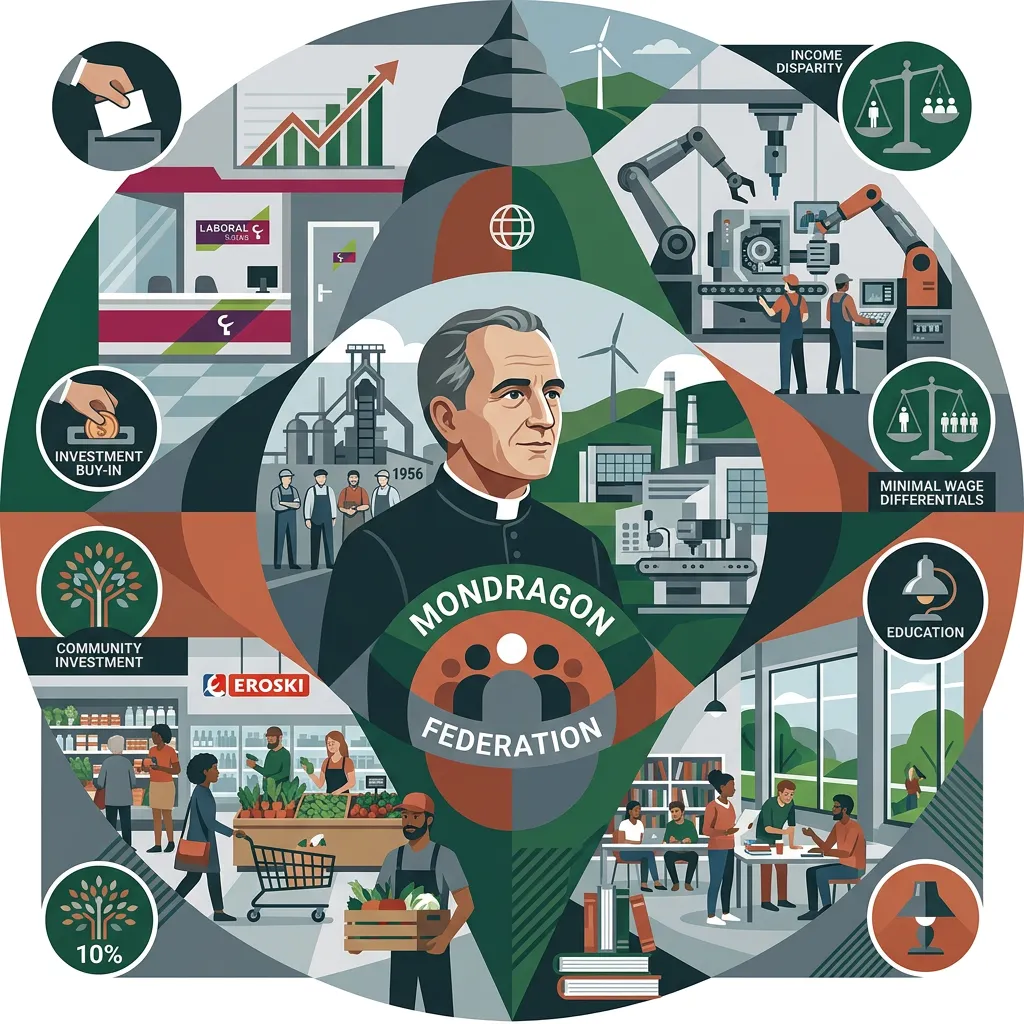
In 1943 he founded a professional polytechnic school, and in 1956 the first cooperative was founded — a steel mill called ULGOR. It started with just five workers.
What Is Mondragon Today?
The Mondragon Corporation is today a federation of worker cooperatives based in the Basque region of Spain, with revenue of €11.2 billion and over 70,000 employee-owners as of 2024. It is the seventh largest company in Spain and the largest worker-owned cooperative federation in the world.
It operates across four divisions:
- Finance — including its own cooperative bank, Laboral Kutxa
- Industry — manufacturing everything from machine tools to household appliances
- Retail — including Eroski, one of the largest supermarket chains in Spain
- Knowledge — including Mondragon University, its own cooperative university
But what makes it truly remarkable isn’t the size. It’s how it works.
How It Actually Works
In a traditional capitalist system, decision-making power and wealth are concentrated in the hands of a few top executives and shareholders. In Mondragon, nearly 70,000 members — from floor workers to top executives — are co-owners of their businesses.
They have voting power at general assemblies, where they weigh in on company strategy and policy. The principle is simple: one person, one vote. Not one share, one vote.
A couple of honest caveats worth including: this one-member-one-vote principle applies to worker-members specifically — Mondragon has historically had a meaningful share of non-member temporary and wage workers, especially in its international subsidiaries, who don’t hold the same voting rights as full worker-owners. And at the federation level, Mondragon isn’t a single direct democracy — each cooperative elects its own Governing Council, sends representatives to a 650-member Cooperative Congress, and that Congress elects a Standing Committee and General Council that coordinate strategy across the whole network. Crucially, though, that federation-level leadership can’t override an individual cooperative’s own General Assembly — member cooperatives joined by vote and can vote to leave, which several have (Fagor’s collapse in 2013, and Ampo and Irizar both voting to leave the corporation in 2008).
To become a member of a cooperative, a worker invests €17,000. This isn’t an entry fee paid out of pocket by people who already have money — it’s typically financed through the cooperative itself, either withheld gradually from the worker’s own paycheck over time, or, less commonly, borrowed upfront from Mondragon’s own cooperative bank, Laboral Kutxa (formerly Caja Laboral). Either way, the capital comes from the worker’s own labor, not from personal savings or outside wealth — the “buy-in” is really a mechanism for converting a portion of a worker’s own earnings into an ownership stake in the enterprise they work at, not a barrier that screens out people without existing capital. The investment is returned to the worker, with interest, when they retire or leave.
As for company profit:
- 60% is reinvested in the business
- 30% goes to employees as capital
- 10% goes to the local community
And perhaps most striking of all: the income disparity between the highest and lowest paid employees is capped at a ratio of 6-to-1, compared with a typical ratio of 344-to-1 in the United States.
Read that again. The CEO makes at most six times what the lowest-paid worker makes. In America’s largest corporations, that ratio is 344 to 1.
Want more analysis like this in your inbox?
New posts every week on cooperative economics, solidarity economy evidence, and the data behind the movement. No spam — ever.
Subscribe at solidarityecono.my →
Built to Survive
One of the most powerful aspects of Mondragon is how it handles hard times. When there was a massive economic downturn in the 1980s and cooperatives were forced to close, other cooperatives in the portfolio that were thriving simply transferred people from one cooperative to another — paying for the education each worker needed to fulfill their new roles.
They also built their own social safety net. When the Spanish government ruled that cooperative owners no longer qualified for the country’s social security program, Mondragon created its own — founding Lagun Aro, a social welfare arm that provides pensions, disability services, and eventually its own healthcare for workers and their families.
This is what a cooperative ecosystem looks like at scale. Not just a business. A society.
The Ten Principles
From the beginning Mondragon strived for:
- Open membership — cooperative ownership available to all
- Democratic organization — one person, one vote
- The sovereignty of labor — work is the primary factor of wealth creation
- Capital as instrumental — money serves people, not the other way around
- Participatory management — workers involved in decisions at every level
- Minimal wage differentials — capped pay ratios between highest and lowest earners
- Cooperation between cooperatives — the ecosystem supports itself
- Social transformation — using cooperative economics to change society
- Solidarity — with other workers and movements locally and globally
- Education — continuous learning as a core cooperative value
These aren’t marketing slogans. They are the operating system of the entire corporation.
Why It Matters for Us
Mondragon is not a utopia. It has faced criticism, made compromises, and wrestled with the pressures of competing in a global capitalist economy. Some of its international subsidiaries are not worker-owned. It has had to adapt.
But here’s what cannot be argued away:
- Nearly 70 years of operation in one of the most competitive industrial economies in the world
- €11.2 billion in revenue generated by worker-owners, not shareholders
- 70,000 people employed with fair wages, capped inequality, and democratic ownership
- Its own bank, university, and healthcare system — built by and for workers
The theory that workers cannot run complex, competitive businesses at scale? Mondragon disproves it every single day.
And it didn’t start with billions of dollars in venture capital. It started with one priest, one town, and five workers who decided to try something different.
The question is not whether it can work. The question is why we aren’t building more of them.
Keep Going
- 🌐 Be part of it — solidarityecono.my
- 📋 Get involved — fill out our intake form
- 🛒 Shop at our Marketplace — solidarityecono.my
This is part of our Theory and Vision series — big ideas, frameworks, and the philosophy behind the new economy. Want to go deeper? Join the Solidarity Economy platform and be part of building it.
Written by the Cooperative Codebase team — Aaron, Israel, and Jamie. Part of the Solidarity Economy Marketplace. Last updated: July 2026.
Comments