
History Bites · 6 min read
From worker-run textile factories in Caracas to 90,000 cooperatives nationwide, Venezuela’s Bolivarian Revolution offers one of the most ambitious experiments in cooperative economics in modern history. What worked, what didn’t, and what it means for us today.
90,000 cooperatives at peak · 1M+ members represented · 1967 the year CECOSESOLA was founded
A Different Kind of Economy
What would it look like if your workplace was owned and run by the people who worked there? If your neighborhood decided together how resources were spent? If profit wasn’t the point — community need was?
Venezuela tried to find out.
This story matters not just as history — but as proof. Because if you’re building something like the Marketplace at solidarityecono.my, you need to know what those who came before you actually did. What they built. What held. What broke. And what was worth building again.
The Roots Go Deep
The cooperative movement in Venezuela didn’t start with Hugo Chávez. As early as the 20th century, Carlos León — a follower of French cooperative theorist Charles Gide — was promoting the founding of cooperatives in Venezuela.
The movement faced fierce repression. León was imprisoned in 1914 and exiled to Mexico in 1923. The idea of people owning their own economic lives was considered dangerous long before it became policy.
CECOSESOLA. Even though it predates Chávez — founded in 1967 as an “Organism for Cooperative Integration” providing funeral services in Venezuela’s Lara state — it not only survived the Chávez era, it expanded massively during it and is still functioning today, which is rare among Venezuelan cooperatives. Multiple researchers describe it as one of the most successful cooperatives in Latin America. They won the prestigious Right Livelihood Award in 2022, sometimes called the “Alternative Nobel Prize.”
The Bolivarian Boom
When Chávez came to power in 1999, cooperatives moved from the margins to the center of economic policy. Much of the country’s oil revenue was directed toward government funding of locally operated cooperatives and microbusinesses — leading to a rapid proliferation of such enterprises across the country.
The numbers are staggering:
- By 2005 the National Superintendence of Cooperatives reported over 70,000 cooperatives operating across Venezuela — in neighborhoods, parks, office buildings, and factories
- By later estimates the number reached approximately 90,000 cooperatives with over a million members
- This represented one of the largest expansions of cooperative economics in modern history
For context, the Mondragon Corporation — widely considered the gold standard of worker-owned cooperatives — has around 70,000 members. Venezuela built something comparable in scale in just a few years.
Real People, Real Work
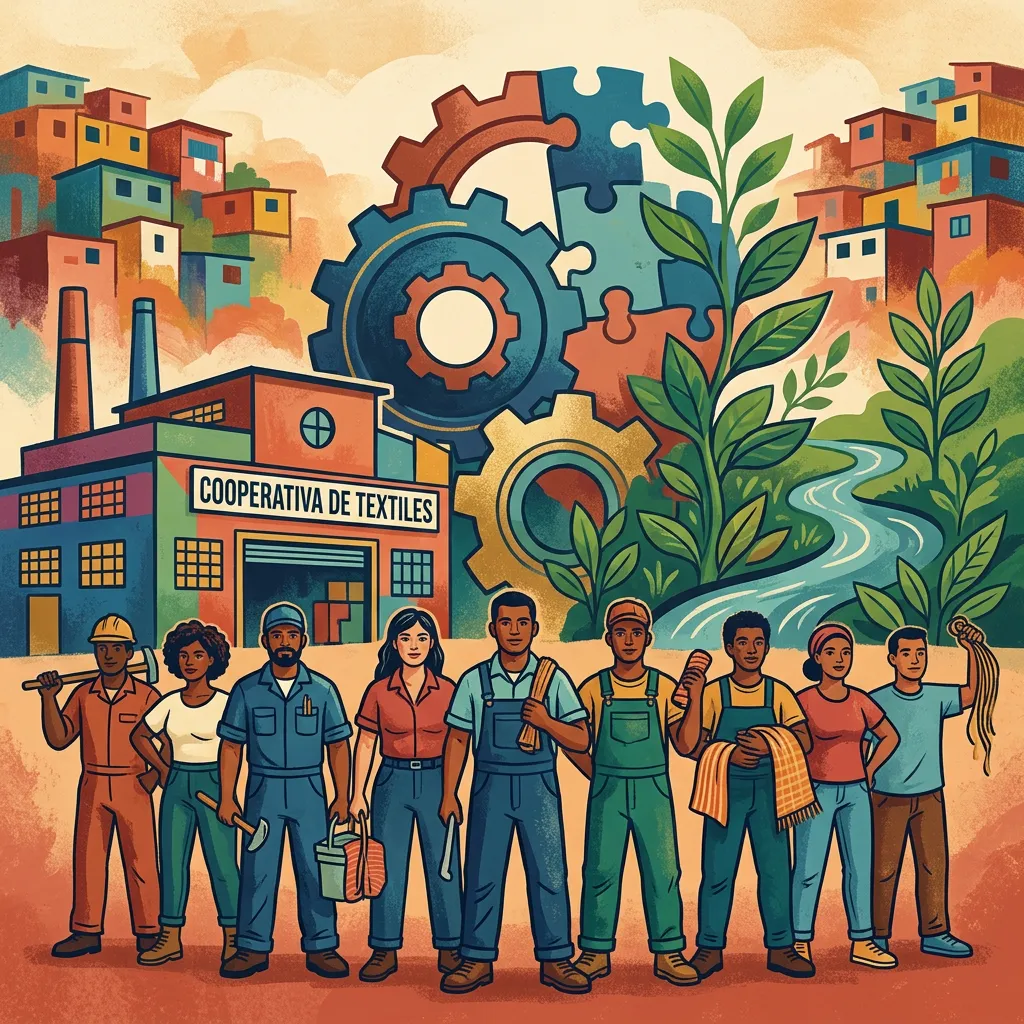
One of the most vivid examples was the Venezuela Avanza textile cooperative in Caracas. Its 209 workers were mostly formerly jobless neighborhood women whose homes on the surrounding steep hillsides were almost all self-built. Workers voted together on their own uniform pay rate and managed the factory collectively.
This wasn’t charity — it was democracy applied to the workplace.
CATURVEN, formed in 2002, became one of the era’s standout successes — a worker-owned cooperative servicing heavy machinery for Caterpillar Inc., competing directly in the industrial sector. It was part of a 17-cooperative alliance with nearly 1,000 members providing Caterpillar equipment service nationwide, and it maintained genuinely tight internal pay equity: less than a 2x gap between its highest- and lowest-paid members. A worker-owned cooperative, competing on equal footing in a global industry — that’s not a small thing.
It’s also, as far as we can confirm, no longer active — though we can’t pin down when or why it stopped operating, and the most recent documentation we could find is now over a decade old. That uncertainty is itself part of the story. CATURVEN emerged from a 2002–2008 Venezuelan government campaign that formally registered over 280,000 cooperatives — the vast majority of which never began operating or quietly failed. CATURVEN was genuinely one of the rare successes to come out of that wave. Whether it’s still one today, we don’t know.
🔗 El éxito silencioso de las cooperativas en Venezuela — PROUT Venezuela
Want stories like this delivered to your inbox?
New posts every week on cooperative history, worker ownership, and the solidarity economy. No spam — ever.
Subscribe at solidarityecono.my →
What Made It Different
The cooperative model in Venezuela was treated as an institution capable of changing the economy in radical ways — one where participation in the project’s success was determined by the work people contributed, not by how much money they had invested.
That’s a fundamentally different set of values than what drives a corporation. In a corporation, capital votes. In a cooperative, people vote.
That’s not a minor distinction. It’s the whole ballgame.
Lessons For Today
Venezuela’s cooperative experiment was not without its contradictions, failures, and complications — no honest history would skip that. The Chávez government’s top-down approach to cooperative development created dependency. Many cooperatives dissolved when government funding dried up. The political context was turbulent and complex.
But a deeper structural problem sits underneath all of that: Venezuela never built the “glue institutions” that made Mondragon durable. Mondragon didn’t just create individual cooperatives — it built Caja Laboral (its own bank), Mondragon Unibertsitatea (its own university), and a solidarity fund that channels a share of every successful cooperative’s profits into supporting struggling ones. Those institutions let cooperatives share capital, talent, and risk across the whole network, rather than sinking or swimming alone.
Venezuela’s cooperatives, by contrast, were largely isolated from each other. A 2006 academic field study of Venezuelan cooperatives found “little integration” existed among them, and recommended — years too late to matter for many of them — that cooperatives needed to coordinate activities amongst themselves to build the kind of interlocking support system Mondragon had. A CENCOOP national gathering did eventually propose building a national cooperative bank and a national cooperative education plan — but this happened only in scattered discussion, well after thousands of cooperatives had already failed without it.
The result was a movement of individual enterprises rather than an actual ecosystem: no shared bank to provide affordable credit when a cooperative hit a cash crunch, no shared university to train the next generation of cooperators, and no solidarity fund to catch a struggling cooperative before it collapsed. Cooperatives that had that kind of mutual infrastructure — Cecosesola, which built its own credit union, health clinic, and internal network of producer cooperatives largely independent of the state — survived. Most that didn’t, didn’t.
But here’s what cannot be argued away:
- 90,000 cooperatives existed and employed over a million people
- Worker-owned factories competed in global industrial markets
- Communities governed themselves through communal councils
- Ordinary people — women in hillside neighborhoods — ran enterprises collectively and paid themselves fairly
The scale of what was attempted, and the real lives it changed, offers something important: proof that another way of organizing an economy is not just theoretical. It has been lived.
The question for us today isn’t whether cooperative economics can work. It’s whether we have the will to build it.
Keep Going
- 🌐 Be part of it — explore the full Solidarity Economy at solidarityecono.my
- 📋 Get involved — fill out our intake form and tell us what you’re building
- 🛒 Shop at our Marketplace — solidarityecono.my
This is part of our History Bites series — bite-sized stories from the history of cooperative and solidarity economics. Want more? Join the Solidarity Economy platform and be part of building it.
Written by the Cooperative Codebase team — Aaron, Israel, and Jamie. Part of the Solidarity Economy Marketplace. Last updated: June 2026.
Comments