Theory and Vision · 7 min read
A kinder boss is still a boss. A public boss is still a boss. The deeper question — the one the cooperative movement insists on asking — is whether we can build a society where the people doing the work also hold the power.
This is not a dismissal of the socialist, communist, and social democratic traditions. Many of their attempts improved life dramatically. The eight-hour workday, the minimum wage, public healthcare, unemployment insurance, public education — these are real gains that matter and are worth defending.
But here is what many of these projects did not do: they did not change the core relationship. The deepest question about any economic system is who owns, who decides, and who benefits at the point of production. On that question, much of the left’s history offers a complicated answer.
What Social Democracy Got Right — and What It Left Intact
Social democracy — a political tradition that seeks to reform capitalism rather than replace it, using state regulation, taxation, and a strong welfare state to redistribute wealth and expand social rights while preserving a market economy and liberal-democratic institutions — achieved something genuinely important. It proved that capitalism could be regulated, taxed, and constrained in ways that dramatically improved working-class life. Universal healthcare. Strong labor protections. Progressive taxation. Unemployment insurance.
But social democracy largely left the ownership structure of the economy intact. The employer still owned the enterprise. The employee still sold their labor. The surplus still flowed to shareholders. The management hierarchy still operated by command.
Social democracy regulated the relationship between owner and employee. It did not transform it.
A welfare state built on top of an unchanged ownership structure is a negotiated truce, not a structural transformation. When the balance of power shifts, the truce ends.
What State Socialism Got Right — and What It Missed
State socialism removed private ownership of the means of production. And in many cases it produced real gains. The Soviet Union industrialized at extraordinary speed. Cuba produced universal literacy and a healthcare system that rivals wealthy countries.
These are not nothing. Any honest accounting of socialist history has to acknowledge them.
But many forms of state socialism did not give workers democratic control of production. The private owner was removed — but replaced by the state manager, the party official, the central planner.
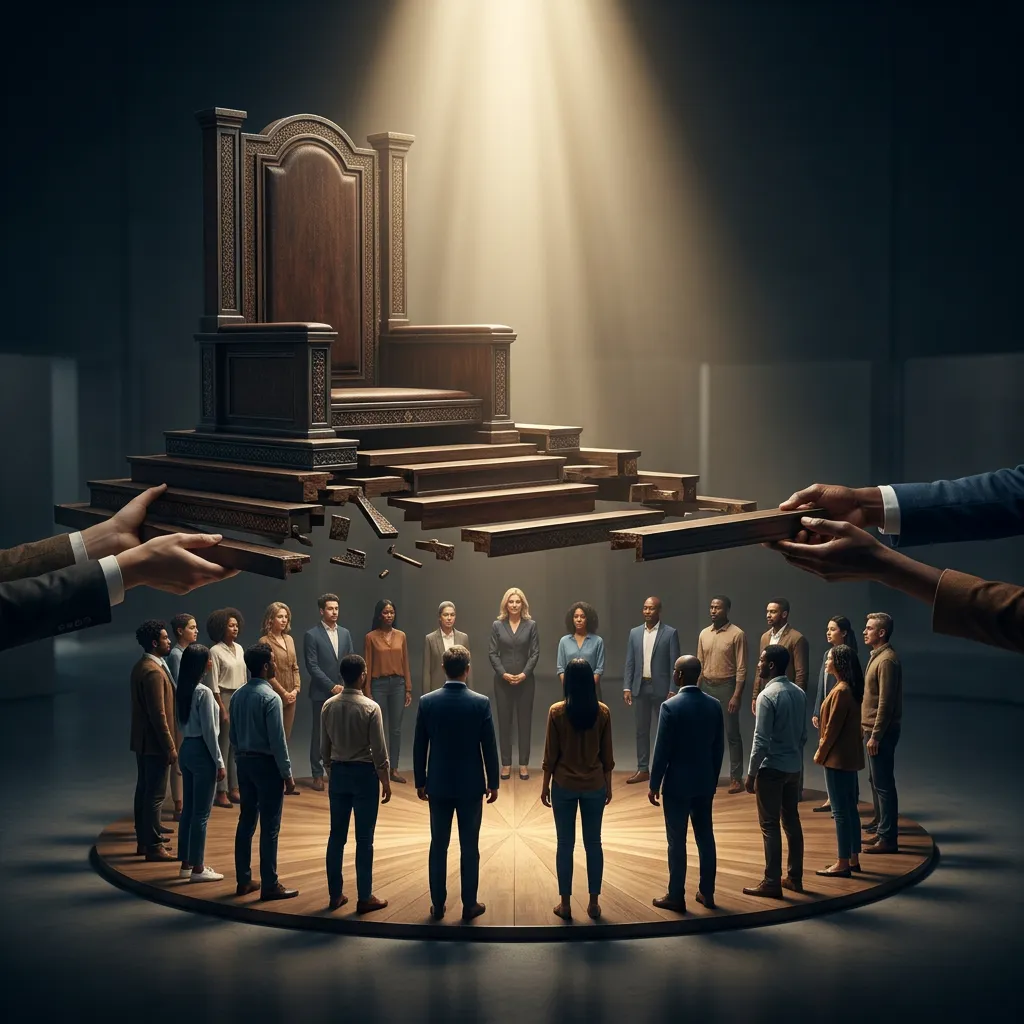
Three figures on the platform. The capitalist with a money bag. The state official with a clipboard. The corporate manager with a tablet. Different costumes. Same position. Above. Commanding. Deciding.
The worker below still received orders rather than issuing them. The surplus still flowed upward — to the state rather than the shareholder, but upward nonetheless.
Nationalization is not the same as worker democracy. Public ownership is not automatically democratic ownership.
Want more theory like this in your inbox?
New posts every week on cooperative economics, solidarity economy theory, and the ideas driving the movement. No spam — ever.
Subscribe at solidarityecono.my →
What Progressive Politics Gets Right — and What It Avoids
Progressive politics has produced some of the most important policy gains of the last century. Occupational safety. Environmental regulation. Civil rights law. Consumer protection.
The difference between a regulated capitalist economy and an unregulated one is the difference between bad and catastrophic for most working people.
But progressive politics has a persistent tendency to treat the symptoms of the owner/employee relationship rather than the relationship itself. A minimum wage law is better than no minimum wage. But it does not change the fact that the employer decides the wage and the worker accepts or leaves.
Welfare is not the same as power. Benefits are not the same as ownership. Representation is not the same as self-governance.
The Harder Question
Not: who should be the boss?
Not: how do we make the boss kinder?
Not: how do we replace the private boss with a public boss?
But: can we build organizations where there is no boss — where the people doing the work hold the power collectively?
This is the question that Mondragon’s 70,000 worker-owners answer every day. That Emilia-Romagna’s cooperative economy has been answering for 140 years. That Equal Exchange’s worker-owners answer when they vote on their own pay structure. That the Drivers Cooperative’s driver-owners answer when they set their own minimum wage.
The answer, in each case, is yes.
What Cooperativism Inherits and What It Adds
From social democracy: the commitment to worker protection, public goods, and the regulation of capital’s worst excesses.
From state socialism: the recognition that private ownership of the means of production is not natural or inevitable.
From progressive politics: the commitment to expanding rights, fighting discrimination, and ensuring benefits reach everyone.
What cooperativism adds is the insistence on democratic ownership at the point of production. Not kinder bosses. Not public bosses. Not regulated bosses. Everyone being their own boss collectively.
This is not utopian. It is demonstrated. Mondragon. Emilia-Romagna. Argentina’s recovered factories. Ethiopia’s coffee cooperatives. The Zapatista autonomous communities. Cooperation Jackson.
The harder question has been answered. The work now is building at scale.
The Three Bosses and Why None of Them Is Enough
The Capitalist Boss — extracts surplus for private shareholders. Social democracy regulated this figure. It did not eliminate the structure.
The State Boss — replaced private ownership with public ownership but often maintained the command relationship. State socialism challenged capital. It did not always challenge hierarchy.
The Corporate Manager — professional management insulated from both owners and workers. Progressive politics diversified this class. It did not democratize the enterprises they run.
Cooperativism does not propose a fourth figure for the platform. It proposes dismantling the platform — and building the circle of workers into the governing body of the enterprise itself.
“At the core of economic democracy is the notion that control should not be vested in a small group of people, but in the people who do the labor.” — Nathan J. Robinson, Why You Should Be a Socialist
Keep Going
- 🌐 Be part of it — solidarityecono.my
- 📋 Get involved — fill out our intake form
- 🛒 Shop at our Marketplace — solidarityecono.my
This is part of our Theory and Vision series — big ideas, frameworks, and the philosophy behind the new economy. Want to go deeper? Join the Solidarity Economy platform and be part of building it.
Written by the Cooperative Codebase team — Aaron, Israel, and Jamie. Part of the Solidarity Economy Marketplace. Last updated: July 2026.
Comments