
Theory and Vision · 7 min read
The Heart of the Machine
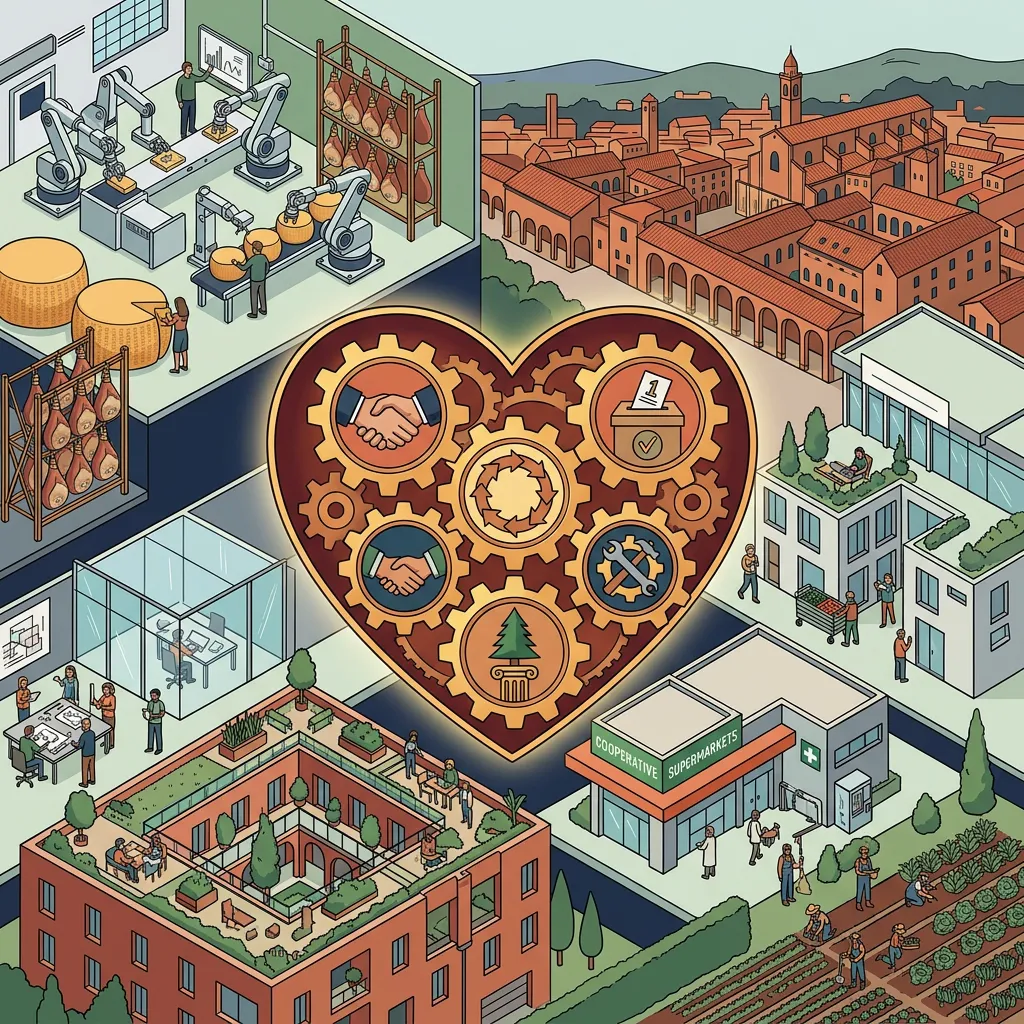
The image above makes the mechanism visible. At the center is a mechanical heart — and inside it, five interlocking gears:
- Social Capital — the dense networks of trust, reciprocity, and civic engagement built over generations
- Cooperation — the structural habit of working collectively rather than competitively
- Democratic Control — one person, one vote, at every level of the enterprise
- Worker Ownership — the legal and financial stake that aligns worker interests with enterprise success
- Institutional Trust — the confidence that cooperative institutions will be there tomorrow, next year, and in the next generation
These aren’t soft values. They are operational mechanisms. Each one produces measurable economic outcomes. Together, they produce an economy that outperforms virtually every comparable region in Europe on the metrics that matter most.
Skeptics say cooperative economies can’t compete. They say worker ownership is inefficient. That democratic governance is too slow. That you can’t run a modern, high-tech, globally competitive economy on solidarity and shared ownership. Emilia-Romagna has been proving them wrong for 140 years. Here’s the data, the mechanisms, and the honest assessment of what actually works — and why.
~40% of regional GDP from cooperatives · €36 billion+ in cooperative revenue annually · Third-highest GDP per capita in Italy
The Question Everyone Asks
When people first hear about Emilia-Romagna’s cooperative economy, the reaction is usually some version of the same question: “But does it actually work?”
It’s a fair question. We’ve all heard about economic models that look great on paper and collapse in practice. We know the history of failed experiments, good intentions gone wrong, and idealistic projects that couldn’t survive contact with market reality.
So let’s answer the question directly, with evidence. Does the Emilia-Romagna model work? Yes, and here is why.
The Economic Evidence
GDP and Productivity. Emilia-Romagna consistently ranks third within Italy by GDP per capita, though at the EU level it ranks lower — sources put it around 10th–11th of 122 EU regions historically, with more recent data (2023) placing it around 123% of the EU average, well behind top performers like Île-de-France or Bavaria. (Emilia-Romagna — Wikipedia)
Cooperatives contribute a real, frequently-cited share of regional GDP, though the exact figure varies by source and year — some put it over 40%, others (more recent academic case studies) closer to a third (30–37.5%). The honest range is roughly a third to 40%, not a single hard number.
Labor productivity in cooperative firms matches or exceeds comparable conventional firms — though the strongest sourcing for this is at the national Italian level rather than Emilia-Romagna specifically, showing a 10–15% productivity increase in cooperatives versus traditional companies.
Employment and Stability. Regional unemployment in Emilia-Romagna has run meaningfully below the national average — in one recent comparison, 5.0% against a 7.7% Italian average, a gap of roughly 2.7 points.
Cooperative firms shed fewer jobs during the 2008 financial crisis — a well-supported finding, though again strongest at the national Italian level rather than region-specific. National data shows an “anti-cyclical function,” with 8% employment growth in cooperatives between 2007 and 2011, even as conventional employment contracted.
The structural reason: worker-owners have a direct incentive to avoid layoffs, since they share in the firm’s outcomes rather than simply drawing a wage from it. This incentive alignment is the mechanism researchers point to behind the anti-cyclical employment pattern.
Income Equality. Emilia-Romagna is one of only five Italian regions — and one of 28 regions across the entire EU — with a share of people at risk of poverty below 10% (2024 data).
- The pay ratio between the highest and lowest earners in cooperative firms is dramatically lower than in comparable conventional businesses
- Wealth generated by the cooperative economy stays in the region rather than flowing to distant shareholders
Business Survival. Cooperative firms in Emilia-Romagna show higher survival rates over 5 and 10 year periods than conventional firms in the same sectors. The federated structure of Legacoop means struggling cooperatives get support rather than simply failing.
The mechanism: since 1992, Italian law (Law 59/1992) has required all cooperatives affiliated with a federation to contribute 3% of their profits into a shared “solidarity fund.” Legacoop’s fund is called Coopfond. These funds exist specifically to support struggling co-ops, back worker buyouts of failing conventional firms, and help with capital equipment purchases — a structural safety net that member cooperatives pay into and can draw on when they hit trouble.
The Sectors That Prove It
High-Tech Manufacturing Co-ops. Emilia-Romagna is home to some of the most sophisticated manufacturing in the world — precision engineering, ceramics, packaging machinery, biomedical devices. Many of these firms are worker-owned cooperatives competing successfully in global markets against much larger conventional corporations.
The “packaging valley” around Bologna — a cluster of worker-owned firms that produces a significant share of the world’s food packaging machinery — is a global export leader. Worker ownership did not make these firms less competitive. It made them more so.
Traditional Food Production Co-ops. The Parmigiano-Reggiano and Prosciutto di Parma cooperatives command premium prices globally that no individual farmer could negotiate alone. This is cooperative economics producing direct, measurable financial returns — not despite the cooperative structure, but because of it.
Professional Services and Design Co-ops. Architecture firms, engineering consultancies, design studios, legal cooperatives — Emilia-Romagna’s professional services sector includes a significant cooperative component that is virtually invisible in the English-language business press but very visible in the regional economy.
Retail, Housing, and Community Services Co-ops. Coop Italia supermarkets — collectively owned by millions of member-consumers — are among the most profitable retailers in Italy. Housing cooperatives provide affordable, democratically governed homes to hundreds of thousands of residents.
Want more analysis like this in your inbox?
New posts every week on cooperative economics, solidarity economy evidence, and the data behind the movement. No spam — ever.
Subscribe at solidarityecono.my →
Why It Works: The Five Mechanisms
1. Worker Ownership Aligns Incentives. In a conventional firm, workers and owners have structurally opposed interests. In a cooperative, workers are owners. That structural conflict disappears. Workers have every reason to make the firm efficient, innovative, and sustainable — because they share in the result.
2. Democratic Control Produces Better Decisions. Research on organizational decision-making consistently shows that decisions made with input from the people closest to the work are better decisions. Worker-owners know things that distant shareholders and hired managers don’t.
3. Social Capital Reduces Transaction Costs. The dense networks of trust in Emilia-Romagna mean that cooperative firms can do business with each other faster, cheaper, and with less legal overhead than comparable conventional firms operating at arm’s length. Trust is not just a nice feeling — it is an economic asset with a measurable value.
4. Institutional Trust Enables Long-Term Thinking. Because worker-owners expect the cooperative to still exist in 20 years, cooperative firms systematically make more long-term investments in training, equipment, and relationships than conventional firms optimized for quarterly returns.
5. Federation Provides Resilience. No cooperative stands alone in Emilia-Romagna. Legacoop provides shared services, financing, legal support, and a solidarity fund that helps struggling cooperatives survive downturns.
“Social capital is highly associated with quality of life everywhere. It seems that the co-operatives’ emphasis on fairness and respect contribute to the accumulation of social capital here.” — Stefano Zamagni, economics professor, University of Bologna
The Honest Caveats
An honest assessment requires acknowledging what the model doesn’t answer:
- Replication is hard. Emilia-Romagna’s cooperative economy was built over 140 years in a specific cultural and political context.
- Scale has limits. The model works brilliantly in networks of small and medium enterprises. Its application to very large, capital-intensive industries is less proven.
- Globalization creates pressure. As supply chains globalize and competition intensifies, cooperative firms face real pressures to cut wages, outsource, and compromise on democratic governance.
- Political support matters. The cooperative economy in Emilia-Romagna has benefited from consistent political support at the regional level for decades. That support is not guaranteed everywhere.
What This Means for Us
If you’re building a cooperative, organizing workers, developing policy, or simply trying to understand whether another economy is possible — Emilia-Romagna gives you the most powerful answer available: a living, breathing, 140-year-old proof of concept.
The model isn’t perfect. No model is. But it works. The data is clear. The mechanisms are understood. The replication, imperfect as it always is, is happening — in Mondragon, in Venezuela, in New Orleans, in the USFWC’s growing network.
The question was never really whether it works. The question is whether we’ll build it.
Keep Going
- 🌐 Be part of it — solidarityecono.my
- 📋 Get involved — fill out our intake form
- 🛒 Shop at our Marketplace — solidarityecono.my
This is part of our Theory and Vision series — big ideas, frameworks, and the evidence behind the new economy. Want to go deeper? Join the Solidarity Economy platform and be part of building it.
Written by the Cooperative Codebase team — Aaron, Israel, and Jamie. Part of the Solidarity Economy Marketplace. Last updated: July 2026.
Comments