
Theory and Vision · 7 min read
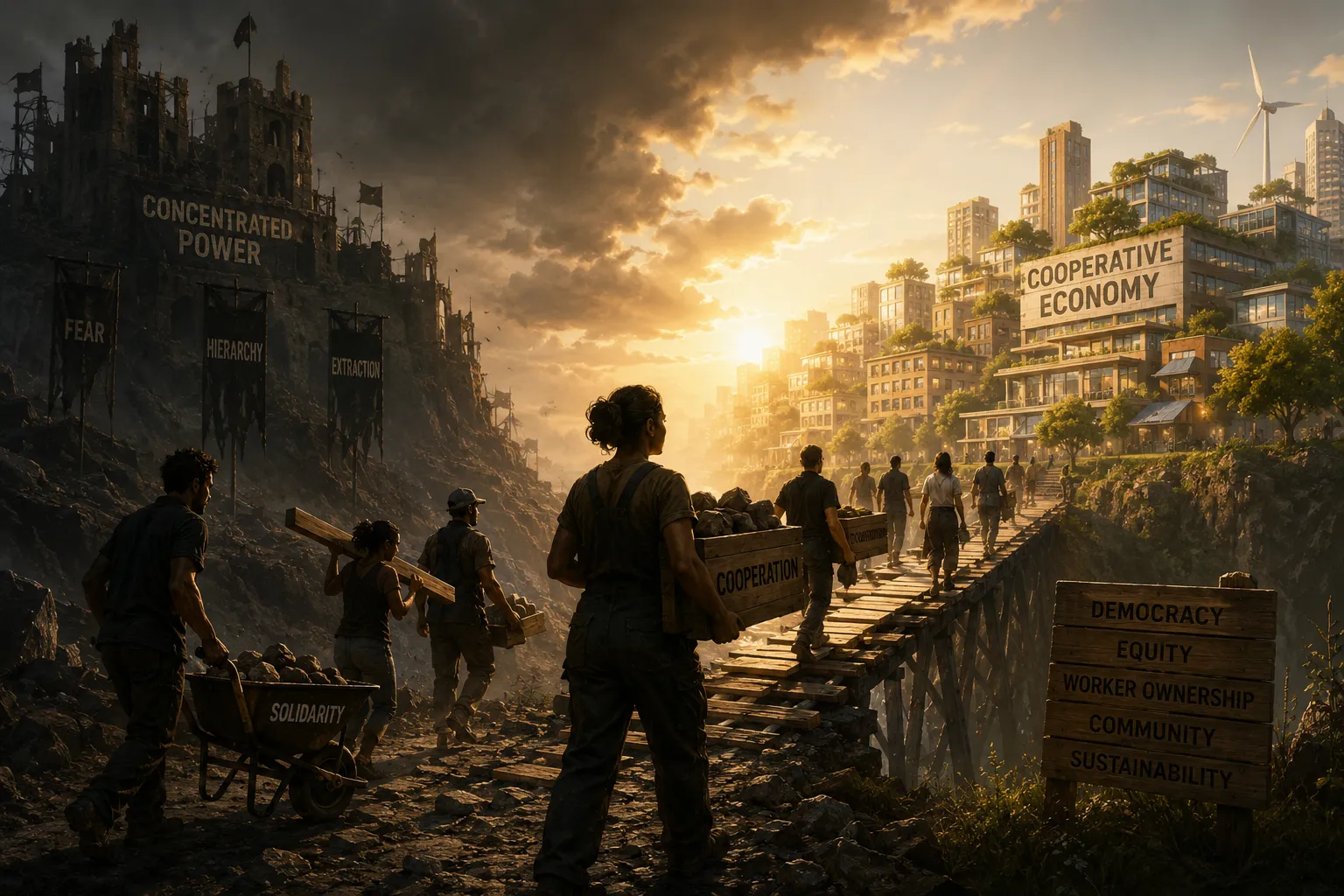
Feudalism did not end because someone made a better argument. It ended because a new form of power grew under its feet — in the merchant cities, in the counting houses, in the trade routes that bypassed the feudal lords entirely. By the time capitalism declared itself victorious, it had already won. The argument came after. The power came first.
The Lesson Nobody Wants to Hear
There is a version of the cooperative movement — the version that loses — that believes moral superiority is enough.
It believes that because worker ownership is more just than corporate extraction, because cooperative economics produces better outcomes for more people, because the evidence from Mondragon and Emilia-Romagna and Equal Exchange is clear and compelling — that these facts alone will cause the old system to yield.
They won’t. Systems do not end simply because they are unjust.
History is not moved by good intentions. It is moved by power. And the question the cooperative movement has to answer — honestly, without flinching — is whether it is building enough of it.
How Systems Actually End
Feudalism was brutal. It imprisoned serfs to the land, concentrated wealth in the hands of lords and clergy, and enforced its hierarchies with violence. And it lasted for centuries.
It did not end because peasants finally made a sufficiently compelling moral argument against serfdom. It ended because a new class — merchants, traders, early capitalists — figured out how to accumulate power differently.
They built trading networks that bypassed feudal territory. They created financial instruments that accumulated wealth faster than land rents. They organized guilds, cities, and eventually states that operated on different principles. By the time feudalism fell, capitalism had already built the world that replaced it.
Capitalism did not defeat feudalism because capitalists were humanists. Many of them were monsters. They won because they were organized, they were building, and they were creating economic facts on the ground that made the feudal order less relevant with every passing decade.
This is the lesson the cooperative movement has to absorb. Not with despair, but with clarity.
The Moral Case Is Not Enough
The cooperative movement has an extraordinarily strong moral case — worker ownership is more just, democratic governance produces better outcomes, cooperative enterprises are more resilient, and the evidence is overwhelming from Emilia-Romagna to Venezuela to Argentina to Cuba.
The moral case is real. The evidence is real. And none of it matters if the cooperative economy remains a principled minority in a world organized around different principles.
Capitalism does not need to be morally defeated. It needs to be economically superseded. The cooperative movement needs to build enterprises, networks, federations, and financial systems that are materially stronger, more useful, and more organizationally capable than what currently exists.
What “Materially Stronger” Actually Means
Scale. Individual cooperatives are powerful. A federation of cooperatives that shares capital, knowledge, and political power is transformational. Mondragon didn’t change the Basque economy with one steel mill. It changed it with 100 cooperatives and their own bank, university, and social insurance system. Scale is not optional. It is the point.
Capital. The cooperative movement needs its own financial infrastructure. Credit unions. Cooperative banks. Community investment funds. The Zapatistas built their own financial system — “popular banks” run as revolving funds that make low-interest loans to community members, with the returns reinvested into new collective projects. Mondragon built its own bank — Caja Laboral, founded in 1959. Cooperation Jackson is building its own cooperative financial institution as part of its long-term vision. Capital that serves workers is built by workers.
Technology. The Drivers Cooperative built a worker-owned rideshare app. Open Collective built financial infrastructure for the solidarity economy. The cooperative movement cannot cede the digital economy to extractive platforms. Platform cooperativism is not a niche — it is a necessity. Trebor Scholz, founding director of the Platform Cooperativism Consortium, makes this case directly in his TED talk, “Stuck in the Gig Economy? Try Platform Co-ops Instead.”
Political Organization. Cooperatives that do not organize politically will have their gains reversed. Argentina’s recovered factories had to fight through courts and legislatures to survive. Emilia-Romagna’s cooperative economy was built with consistent regional political support over generations. The moral case gets you into the room. The political organization is what keeps you there.
Education. You cannot build a cooperative economy without cooperative education. Mondragon’s first institution was a polytechnic school. Cooperation Jackson’s Kuwasi Balagoon Center trains worker-owners in economic democracy. Equal Exchange’s curriculum makes every new worker-owner understand the history and principles of the cooperative they’ve joined. Education is infrastructure.
Want more theory like this in your inbox?
New posts every week on cooperative economics, solidarity economy strategy, and the ideas driving the movement. No spam — ever.
Subscribe at solidarityecono.my →
The New Class That Has to Win
Capitalism replaced feudalism because a new class built the economic base of a new world inside the shell of the old one. They didn’t ask feudalism’s permission. They built until their world was more real than the world they were replacing.
The cooperative movement is building a new class — a class of people who know how to organize democratic economic institutions and are doing it. The worker-owners of Mondragon. The 120+ worker-owners of Equal Exchange. The driver-owners of the Drivers Cooperative. The farmers of Ethiopia’s OCFCU. The indigenous communities of Chiapas. The recovered factory workers of Argentina. The community members of Cooperation Jackson.
Scale in an unexpected sector — home care. Cooperative Home Care Associates (CHCA), Bronx, NY. Founded 1985 with 12 home health aides; now the largest worker cooperative in the United States, with over 2,000 worker-owners providing home care. (Source: Democracy at Work Institute)
A century-old cooperative building actual infrastructure — India. The Uralungal Labour Contract Co-operative Society in Kerala — a worker co-op that literally builds roads, bridges, and public infrastructure projects, running for over a century. (List of Worker Cooperatives — Wikipedia)
Big enough to be a real player in a national market — UK. Suma Wholefoods in West Yorkshire — a worker collective with strict pay parity across all worker-owners, and turnover in the tens of millions of pounds. (Worker cooperative — Wikipedia)
Cocoa/chocolate — West Africa. Kuapa Kokoo, Ghana — over 100,000 farmer members, the largest Fairtrade cocoa cooperative in the world, and co-owner (20%) of Divine Chocolate, a UK company they helped found specifically so farmers could capture value further up the supply chain rather than just selling raw beans. (Kuapa Kokoo — Wikipedia) One honesty flag: there have been recent corruption allegations against Kuapa Kokoo’s leadership reported in Ghanaian press — worth knowing if you cite them, since it’s a live controversy, not settled history.
A worker co-op that converted from a conventional business to save jobs — U.S. manufacturing. Namaste Solar (Boulder, CO) — restructured into a worker co-op in 2011 specifically to align capital structure with democratic governance. Also Alvarado Street Bakery (Sonoma County, worker co-op since 1981, 100+ employees) and Isthmus Engineering & Manufacturing (Madison, WI, custom automation, 30+ worker-owners since 1980). (Source: Democracy at Work Institute)
Multi-stakeholder model — consumer + worker owners together. Weaver Street Market, North Carolina — grocery/community center co-owned by both 18,000+ consumer members and 175 employee-owners. (Source: Democracy at Work Institute)
This class exists. It is growing. It is building economic facts on the ground that make the extractive economy less relevant with every cooperative formed, every worker-owner installed, every community that decides to own its own economic life.
The Hard Truth and the Real Hope
Here is the hard truth: the cooperative movement is not yet strong enough.
The evidence for cooperative economics is overwhelming. The moral case is airtight. The historical proof is abundant. And the cooperative sector is still a small minority of the global economy.
That’s not because the model doesn’t work. It’s because cooperatives, on their own, don’t dismantle the deeper structure they’re embedded in. A worker-owned firm still has to compete in a market. It still has to make a profit to survive. It still operates inside a system of private property and capital accumulation — it just distributes the proceeds more democratically than a conventional firm does. That’s not a small thing. But it’s not the same thing as ending the relation of private ownership over the means of production altogether.
Cooperatives are not the finish line. They are a foothold — proof that democratic ownership is viable, a training ground for the kind of self-governance a genuinely post-capitalist economy would require at scale, and dual power built one enterprise at a time. Whether that foothold is enough on its own, or whether it’s one tool among others needed to actually transform the system, is a real and open debate inside the movement itself. But treating cooperatives as the endpoint — rather than a step toward something further — undersells both the scale of the problem and the ambition the cooperative movement’s own founders actually had.
That is not a reason for despair. It is a description of the work that remains.
The future will not come because cooperativism is morally better. It will come because cooperativism becomes materially stronger — more organized, more capitalized, more politically coherent, more technologically capable — than the extractive economy it is replacing.
That is not a hope. That is a project. And it is already underway.
“The old world is dying, and the new world struggles to be born: now is the time of monsters.” — Antonio Gramsci, Prison Notebooks (1930)
This is not a distant vision. It is happening right now — in Jackson, Mississippi and Mondragón, Spain; in the coffee highlands of Ethiopia and the jungle communities of Chiapas; in New York City taxis and Boston fair trade warehouses; in recovered factories in Buenos Aires and autonomous communes in northern Syria.
The thread is growing. The question is whether you’re part of it.
Keep Going
- 🌐 Be part of it — solidarityecono.my
- 📋 Get involved — fill out our intake form
- 🛒 Shop at our Marketplace — solidarityecono.my
This is part of our Theory and Vision series — big ideas, frameworks, and the philosophy behind the new economy. Want to go deeper? Join the Solidarity Economy platform and be part of building it.
Written by the Cooperative Codebase team — Aaron, Israel, and Jamie. Part of the Solidarity Economy Marketplace. Last updated: July 2026.
Comments