
Best of Spotlights · 7 min read
Jackson, Mississippi is one of the poorest cities in America, in the poorest state in the country. Unemployment is high. Disinvestment runs deep. The infrastructure is crumbling. And in the middle of all of that, a network of worker-owned cooperatives is building something they explicitly describe as “the Mondragón or Emilia-Romagna of the United States.” Their name is Cooperation Jackson. And what they are building is one of the most ambitious solidarity economy projects in American history.
Sources: Jackson among the most impoverished cities in US — WJTV · Mississippi: The Poorest US State — Eurasia Review · The Story of Cooperation Jackson — Defend Democracy Press
2014 — Cooperation Jackson founded · 939 W. Capitol St. — home base in Jackson, Mississippi · 4 interconnected institutions being built simultaneously
Where It Comes From
Cooperation Jackson didn’t appear from nowhere. Its roots lay deep within the struggle for democratic rights, economic justice, and self-determination, particularly for Black people in the Deep South.
The organization is the direct outgrowth of the Jackson-Kush Plan — a long-term political and economic strategy developed by the New Afrikan People’s Organization and the Malcolm X Grassroots Movement. The plan called for building independent Black political power in Mississippi alongside a cooperative economic base that could sustain that power materially.
The movement stands on the shoulders of Mississippi’s long history of cooperative economics — from Fannie Lou Hamer’s Freedom Farm Cooperative of the 1960s to the civil rights movement’s economic self-determination tradition. This is not a new idea in Mississippi. It is a very old one, being rebuilt.
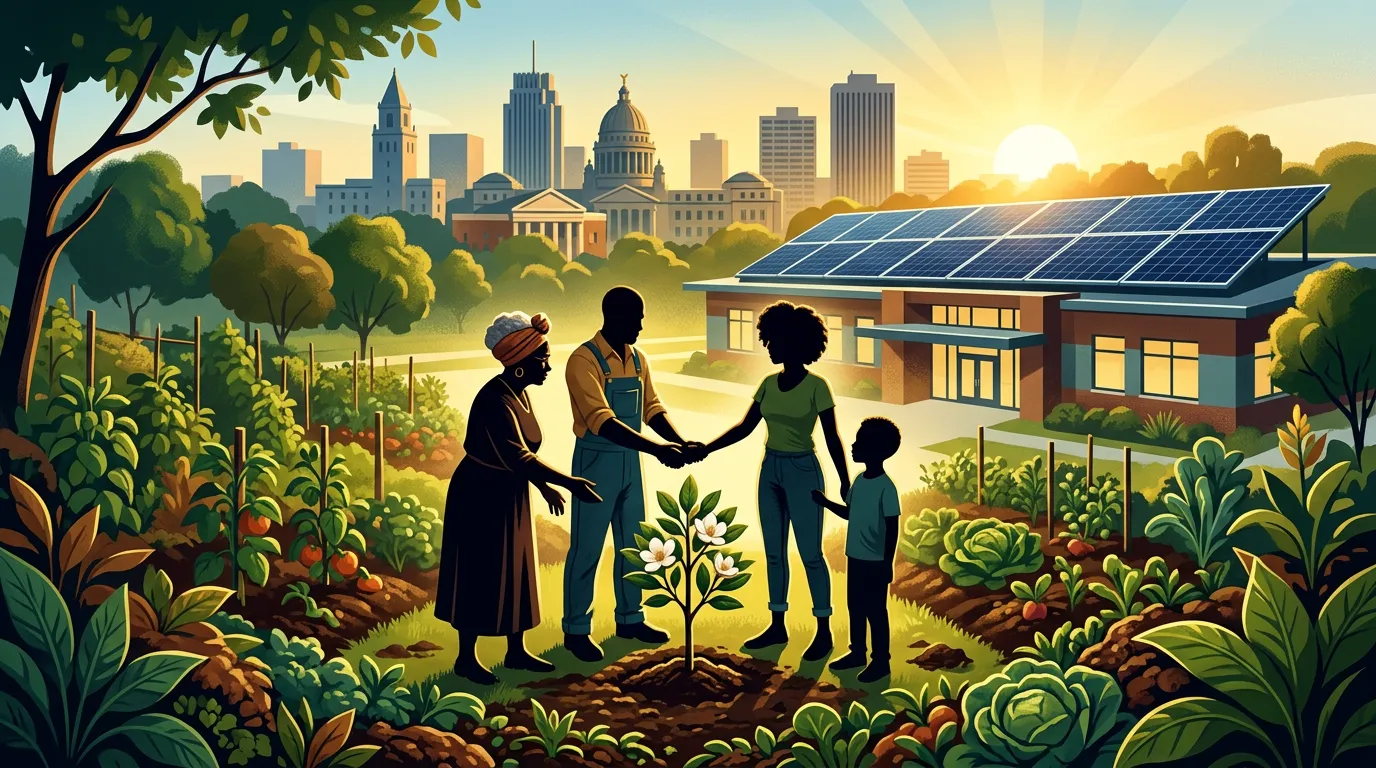
The Context: Why Jackson, Why Now
Mississippi is the poorest state in the union. The working peoples of Jackson are beset by numerous unmet economic and social needs — lacking jobs, living wages, workers rights, and access to affordable high quality foods, health care, and housing.
Jackson is also a majority Black city — over 80% — with a history of racial economic exclusion that runs from slavery through Jim Crow to contemporary disinvestment. The cooperative movement in Jackson is explicitly a response to that history. It is an attempt to build, from the bottom up, the economic infrastructure that racial capitalism never provided and never will.
Cooperation Jackson’s basic theory of change is centered on organizing and empowering the structurally under and unemployed sectors of the working class, particularly from Black and Latino communities, to build worker organized and owned cooperatives as a catalyst for the democratization of the economy and society overall.
The Four Institutions
Cooperation Jackson’s long-term vision is to develop four interconnected institutions:
- A federation of local worker cooperatives — the heart of the project, a network of worker-owned enterprises that support each other, share resources, and collectively build the economic base of the community
- A cooperative incubator — providing technical assistance, training, shared infrastructure, and startup support to worker-owners launching new enterprises
- The Kuwasi Balagoon Center for Economic Democracy and Development — education and training in cooperative economics, economic democracy, and political education
- A cooperative bank — providing cooperative enterprises with access to credit and financial services on terms designed for worker-owned businesses
What They’ve Built
The Ida B. Wells Plaza. As of 2024, the network was nearing completion of the Ida B. Wells Plaza — a planned business center including Eversville Design & Print Shop, Chief Farms (a medical cannabis cooperative), and a cooperative grocery called People’s Grocery. All land acquisition and cooperative startups through Phase 2 were completed without taking on debt.
Zero Waste Jackson. A worker cooperative providing composting, recycling, and waste management services — building the ecological infrastructure of a sustainable economy while providing dignified, worker-owned employment. Confirmed active, partnering with Keep Jackson Beautiful on plastic waste collection at the Ida B. Wells Plaza.
Freedom Farms. Cooperation Jackson’s urban agriculture cooperative — building food sovereignty in a city with deep food access challenges through collectively owned, community-governed food production. Confirmed: currently producing on 2 acres within the Fannie Lou Hamer Community Land Trust, selling produce locally in restaurants and grocery stores.
The FabLab. A community fabrication laboratory giving community members access to 3D printers, laser cutters, CNC machines, and digital fabrication tools. Cooperative economics meeting the digital economy — ensuring that the tools of 21st-century production are accessible to working-class Black communities.
Want more stories like this in your inbox?
New posts every week on cooperative economics, solidarity economy history, and the movements building a better world. No spam — ever.
Subscribe at solidarityecono.my →
Democratic Decision-Making: The People’s Assembly
Cooperation Jackson operates within a broader tradition of participatory democracy through the Jackson People’s Assembly — community gatherings where residents make collective decisions about the direction of the cooperative network and the broader political economy of the city.
This is what makes Cooperation Jackson different from a simple cooperative business network. It is simultaneously an economic project and a political project — building what movement organizers call “dual power,” the capacity to meet community needs independently of both the corporate market and the state, a term Cooperation Jackson has explicitly adopted to describe its own strategy.
The Explicit Vision: Mondragon in Mississippi
They believe they possess the potential of becoming the Mondragon or Emilia-Romagna of the United States, and in the process transform the lives of working class Jacksonians.
This is not modest language. Mondragon is a €11 billion federation of worker cooperatives with 70,000 members. Emilia-Romagna is a regional economy where 40% of GDP comes from cooperative enterprises. These are the benchmarks Cooperation Jackson has set for itself.
Why Jackson Matters to Everyone
- It is happening in the most hostile possible terrain — the poorest state in America, with a history of racial terror and economic exclusion. If cooperative economics can work here, it can work anywhere.
- It connects race and class explicitly — Cooperation Jackson insists that you cannot separate racial justice from economic democracy.
- It thinks at scale — the Mondragon comparison is not accidental. Cooperation Jackson is trying to build the economic infrastructure of a transformed city.
- It proves the USFWC model works — Cooperation Jackson is living proof that the national cooperative infrastructure being built in America has roots in the communities that need it most.
“We believe that we can replace the current socio-economic system of exploitation, exclusion and the destruction of the environment with a proven democratic alternative.” — Cooperation Jackson, “Who We Are”
Keep Going
- 🌐 Be part of it — solidarityecono.my
- 📋 Get involved — fill out our intake form
- 🛒 Shop at our Marketplace — solidarityecono.my
This is part of our Best of Spotlights series — shining a light on the cooperative businesses and projects building the new economy. Know a cooperative we should feature? Reach out through solidarityecono.my.
Written by the Cooperative Codebase team — Aaron, Israel, and Jamie. Part of the Solidarity Economy Marketplace. Last updated: July 2026.
Comments