
History Bites · 8 min read
Cuba’s relationship with cooperative economics predates the revolution by decades. From the tobacco farmers who organized against Spanish colonial landlords to the urban worker cooperatives opening in Havana today, the island has been running one of the world’s most complex and contested experiments in collective ownership for over a century. This is that story — the full one, contradictions and all.
1959 — agrarian reform launches Cuba’s cooperative era. The First Agrarian Reform Law took effect on May 17, 1959, redistributing land to roughly 200,000 farmers and organizing them into Credit and Service Cooperatives (CCS) — the beginning of Cuba’s cooperative system.
2013 — urban non-agricultural cooperatives legalized for the first time. Cuba’s National Assembly adopted its first-ever law governing non-agricultural cooperatives, following a 2011 push from the Cuban Communist Party congress.
Before the Revolution: The Vegueros
The cooperative tradition in Cuba didn’t begin with Fidel Castro. It began with tobacco.
In the 17th and 18th centuries, Cuba’s tobacco farmers — known as vegueros — were among the most organized agricultural workers in the Caribbean. Facing exploitation from Spanish colonial merchants who controlled pricing and distribution, vegueros formed mutual aid societies and collective bargaining networks to resist extraction and protect their livelihoods.
By the early 20th century, Cuban workers across industries — dockworkers, cigar rollers, sugar cane cutters — had built a robust tradition of mutual aid societies and anarcho-syndicalist labor organizing, including Cuba’s first national sugar workers’ union, formed in 1932, and a cigar-worker organizing tradition dating back to the 1850s–60s — collective resistance that would later provide the social infrastructure for the revolution itself.
The Revolution and Agrarian Reform: 1959
When Fidel Castro’s revolutionary government took power in January 1959, one of its first and most consequential acts was the First Agrarian Reform Law — signed in May of that same year.
The law broke up the large sugar and cattle estates — many owned by U.S. corporations — and redistributed land to the farmers who worked it. By 1963, a Second Agrarian Reform had extended this further, nationalizing medium-sized farms and pushing the cooperative and state farming model to cover the majority of Cuban agriculture.
Two distinct cooperative structures emerged:
CPA — Cooperativas de Producción Agropecuaria. Agricultural Production Cooperatives, where farmers collectively owned land and equipment and worked it together. These were the closest to a true worker cooperative model — members had ownership stakes, shared decision-making, and divided surplus among themselves.
CCS — Cooperativas de Crédito y Servicios. Credit and Services Cooperatives, where farmers retained individual plots but shared access to equipment, credit, and marketing infrastructure. A lighter form of collective organization that preserved individual ownership while enabling collective bargaining power.
At their peak, Cuba had over 6,600 agricultural cooperatives — spanning Credit and Service Cooperatives (CCS), Agricultural Production Cooperatives (CPA), and Basic Units of Cooperative Production (UBPC) — involving close to half a million farmers across the island.
The Special Period: Crisis as Catalyst
In 1991, the Soviet Union collapsed. Cuba lost over 80% of its trade with the outside world almost overnight. The economy contracted by roughly a third — most sources put the GDP decline between 33% and 35% between 1989 and 1993. Food shortages became severe. The government called it the Período Especial en Tiempo de Paz — the Special Period in a Time of Peace.
UBPC — Unidades Básicas de Producción Cooperativa. Facing the collapse of state farm productivity, the Cuban government in 1993 converted over 1,400 state farms into worker-managed cooperatives — the Basic Units of Cooperative Production. Land was leased to worker collectives, who managed production and kept a share of what they produced.
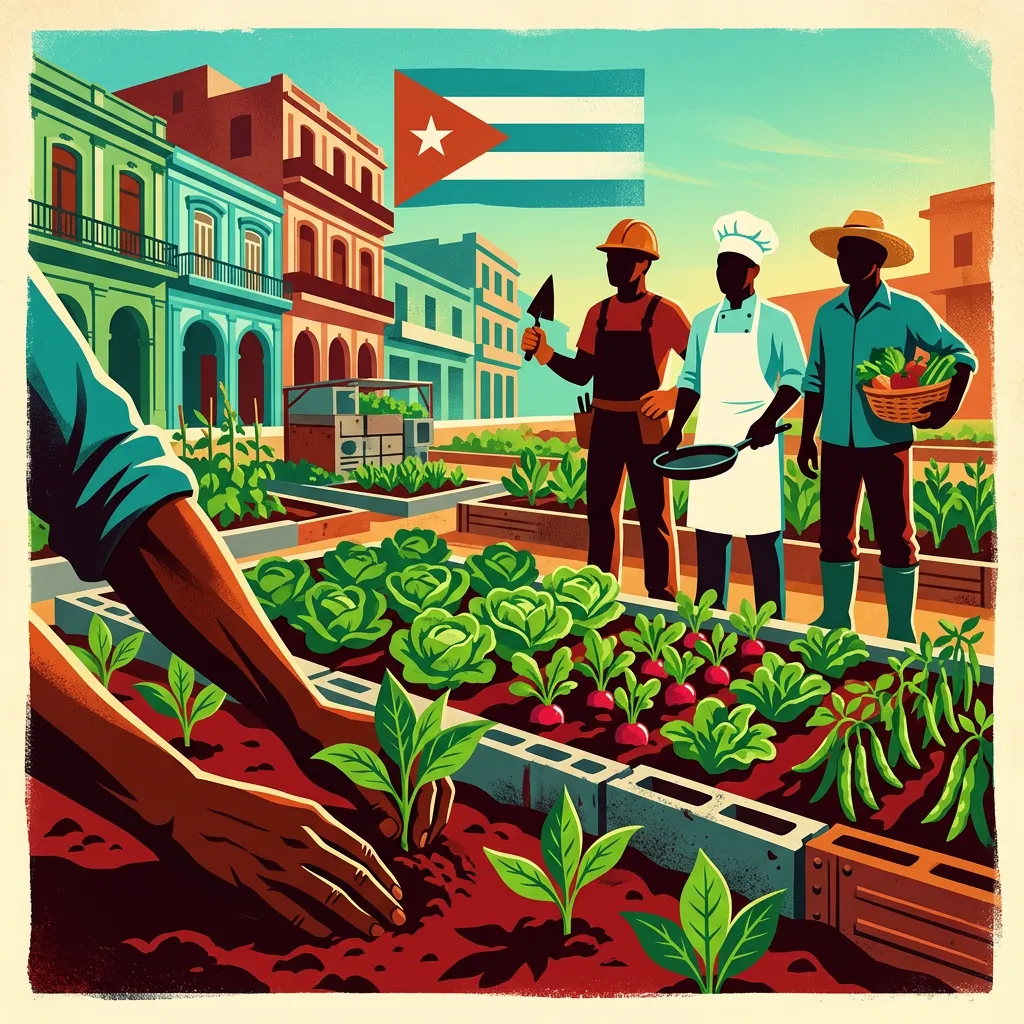
Urban Agriculture. With food imports collapsing, Cubans turned to urban agriculture on a scale never seen in a modern city. Havana’s organopónicos — urban organic farms — were often organized as cooperatives, turning vacant lots, rooftops, and public spaces into productive food systems. By the late 1990s, Havana was producing the majority of its own vegetables within city limits.
According to the Food and Agriculture Organization of the United Nations, Cuba’s urban agriculture program became a global model for food sovereignty and urban cooperative farming.
Want more history like this in your inbox?
New posts every week on cooperative economics, solidarity economy history, and the movements building a better world. No spam — ever.
Subscribe at solidarityecono.my →
The 2011 Reforms: Opening the Door
For decades, Cuba’s cooperative model was almost entirely agricultural. Urban workers, service workers, and professionals had no cooperative structure available to them.
That began to change with the 2011 Lineamientos — the economic guidelines approved by the Communist Party that authorized a significant expansion of non-state economic activity.
In 2013, Cuba legalized non-agricultural worker cooperatives for the first time in its history.
The initial wave included:
- Restaurants and cafeterias — some of Havana’s most celebrated paladares converted to cooperative ownership
- Construction brigades — worker-owned building and renovation cooperatives
- Barbershops and beauty salons — previously state-run, now worker-managed
- Transportation cooperatives — taxi and transit worker collectives
- Retail and market cooperatives — agricultural markets and wholesale supply operations
By 2016, over 400 non-agricultural cooperatives had been authorized, employing thousands of urban workers in cooperative enterprises for the first time.
What Makes Cuba’s Model Distinct
State Coexistence. Cuban cooperatives exist within a socialist state economy, not in opposition to it. They are not an alternative to state provision — they are a complement to it. Housing, healthcare, and education remain state-provided. Cooperatives operate in the productive and service sectors alongside state enterprises.
Land Tenure. In agriculture, land tenure varies by cooperative type. UBPC members work land leased rent-free from the state on indefinite usufruct — they never hold title to it. CPA members historically pooled land they privately owned into collective ownership, receiving payment for it over a set period before becoming collective owners of the cooperative’s assets. CCS members retain private ownership of their individual land the entire time, pooling only credit, equipment, and marketing through the cooperative. This is a genuinely different — and more varied — picture than the Mondragon model or the Emilia-Romagna tradition, where cooperative ownership more consistently includes the underlying productive assets.
Democratic Limits. Cuba’s cooperatives operate within a one-party political system. The degree of genuine democratic self-governance varies significantly across different cooperative types and different periods — an honest accounting of the Cuban model requires acknowledging that tension directly.
Resilience Under Pressure. What is undeniable is the extraordinary resilience of Cuba’s cooperative institutions. They survived the U.S. embargo, the collapse of Soviet support, severe food crises, and multiple waves of economic restructuring. That durability is itself evidence of something.
The Cuban story with cooperatives is not a simple success story or a simple failure. It is something more useful than either: a century of real evidence about what collective ownership can do under extreme conditions — and what it needs to truly flourish. As Cuban economist Camila Piñeiro Harnecker has argued, the country’s cooperative sector offers genuine lessons for how democratic, internally accountable cooperatives might function as a real pillar of a post-state-controlled economy — lessons that go well beyond Cuba’s borders.
Sources: Cooperatives and Socialism: A View from Cuba — Harvard Book Store · Cooperatives and Socialism: A View From Cuba — Foreign Affairs book review
The Lessons
Cuba’s cooperative history is messy, contested, and genuinely instructive. Here is what the evidence shows:
- Cooperatives can feed a nation — Cuba’s agricultural cooperatives demonstrated that collective farming can be highly productive under the right conditions
- Urban cooperatives work — the post-2013 expansion showed that worker-owned service businesses in cities are viable and popular when given legal space to exist
- Ownership structure matters — the tension between leased land and genuine cooperative ownership has limited the depth of worker democracy in Cuban agriculture
- Political context shapes everything — cooperatives flourish when they have genuine autonomy; they struggle when they are too tightly controlled by external authorities, whether state or corporate
Keep Going
- 🌐 Be part of it — solidarityecono.my
- 📋 Get involved — fill out our intake form
- 🛒 Shop at our Marketplace — solidarityecono.my
This is part of our History Bites series — bite-sized stories from the history of cooperative and solidarity economics. Want more? Join the Solidarity Economy platform and be part of building it.
Written by the Cooperative Codebase team — Aaron, Israel, and Jamie. Part of the Solidarity Economy Marketplace. Last updated: July 2026.
Comments