
History Bites · 8 min read
Emilia-Romagna shouldn’t exist — at least not according to conventional economic theory. It is one of the wealthiest, most productive, and most equitable regions in Europe, built not by billionaires or corporations but by farmers, artisans, and laborers who decided to own things together. This is the story of how they did it — and why it still matters today.
40% of the region’s GDP produced by cooperatives · 15,000+ cooperative enterprises · Third-wealthiest region in Italy, ranking among the top 10 economic regions in the European Union
A Region Unlike Any Other
Emilia-Romagna is a stretch of northern Italy running from the Apennine mountains to the Po Valley. Its cities — Bologna, Modena, Parma, Reggio Emilia — are world-famous for food, design, and culture. Parmigiano-Reggiano. Prosciutto di Parma. Ferrari. Ducati. Lamborghini.
But what makes Emilia-Romagna truly extraordinary isn’t the brands. It’s the ownership structure underneath them.
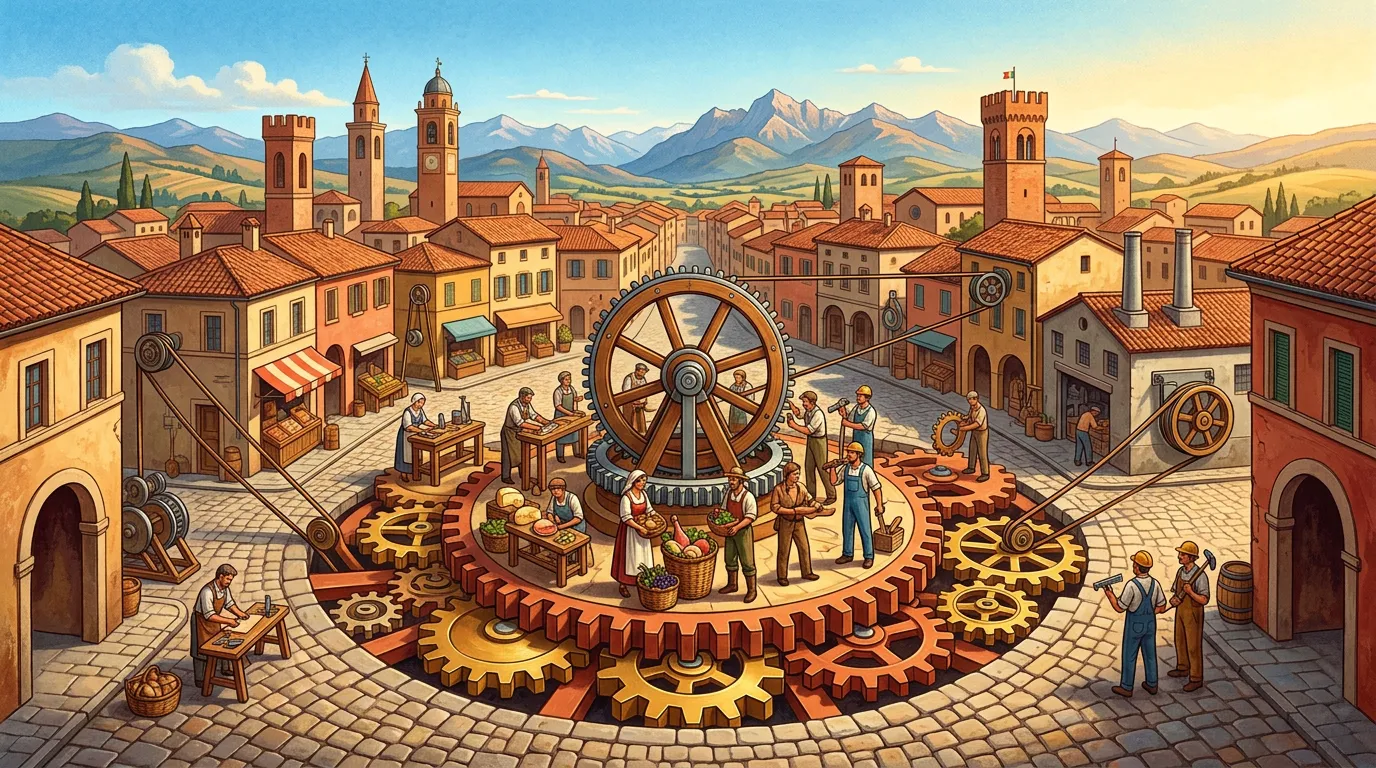
Roughly 40% of the region’s entire GDP is produced by cooperative enterprises. Worker-owned factories. Consumer cooperatives. Agricultural cooperatives. Construction cooperatives. Credit cooperatives. A cooperative economy so deeply woven into the fabric of daily life that it is simply how things work — not an alternative to the mainstream, but the mainstream itself.
The Roots: Red Emilia
To understand how this happened, you have to go back to the 19th century — and to a political tradition so strong it gave the region a nickname it still carries: “Red Emilia.”
The cooperative movement in Emilia-Romagna emerged from the same conditions that drove cooperative movements everywhere: industrial capitalism concentrating wealth at the top while agricultural and industrial laborers had nothing. But in Emilia-Romagna, the response was unusually organized, unusually persistent, and unusually political.
The region had deep roots in the Italian socialist and anarchist movements of the late 1800s. The first cooperative in Emilia-Romagna was founded in 1886 — when laborers in Bologna organized to collectively own their means of production rather than sell their labor to private owners.
What followed was a century of cooperative institution-building unlike anything else in the modern world.
What They Built
Agricultural Cooperatives. Farmers across the Po Valley organized into cooperatives that collectively owned processing facilities, negotiated with buyers, and shared equipment and expertise. Rather than competing against each other and being picked off by large agribusinesses, they competed together.
The result was the protected designation system that today guarantees the authenticity of Parmigiano-Reggiano, Prosciutto di Parma, and dozens of other regional products — a cooperative-built quality standard that commands premium prices on global markets.
Construction Cooperatives. The construction sector in Emilia-Romagna became dominated by worker-owned cooperatives. Cooperative Construction (CCPL) and others became some of the largest construction enterprises in Italy — building infrastructure, housing, and public buildings across the country while remaining owned by their workers.
Consumer Cooperatives. Coop Italia — the national consumer cooperative federation — has deep roots in Emilia-Romagna. Its supermarkets are among the largest grocery retailers in Italy, collectively owned by millions of member-consumers who share in the surplus and govern the business democratically.
The “Third Italy” Model. Academics studying Emilia-Romagna in the 1970s and 80s coined the term “Third Italy” to describe what they were seeing: a regional economy that was neither the large-scale industrial capitalism of the north nor the underdeveloped south, but something genuinely different. Networks of small and medium cooperative enterprises, sharing knowledge and resources, producing world-class goods with unusually equitable distributions of wealth.
The Numbers That Shouldn’t Be Possible
Emilia-Romagna consistently produces results that conventional economic theory struggles to explain:
- It’s the third-wealthiest region in Italy by GDP per capita, ranking among the top 10 wealthiest regions in the entire EU out of 122.
- Its unemployment rate sits well below the Italian national average — 4.9% versus 7.7% nationally as of 2023.
- It’s one of only 28 regions across the whole EU where less than 10% of people are at risk of poverty.
- It has over 15,000 cooperative enterprises, employing hundreds of thousands of workers.
- Cooperatives generate 40% of the region’s entire GDP.
These numbers don’t fit the story we’re usually told — that worker ownership is inefficient, that cooperatives can’t scale, that democratic governance slows decision-making down. Emilia-Romagna disproves every one of those claims, simultaneously, for over a century.
Want more history like this in your inbox?
New posts every week on cooperative economics, solidarity economy history, and the movements building a better world. No spam — ever.
Subscribe at solidarityecono.my →
The Legacoop Connection
The cooperative movement in Emilia-Romagna is organized through Legacoop — the League of Cooperatives — one of the three main cooperative federations in Italy. Legacoop provides:
- Legal and financial support to member cooperatives
- Shared services that reduce costs for smaller cooperatives
- Political advocacy at the regional and national level
- A solidarity fund that helps struggling cooperatives survive downturns
This federated structure is one of the key reasons the Emilia-Romagna model has proven so durable. Individual cooperatives don’t stand alone — they stand together.
It’s the same principle that drives Mondragon’s federation model in the Basque Country, the USFWC in the United States, and Cooperation New Orleans in the Gulf South.
Surviving Fascism
One of the most remarkable chapters in the story of Emilia-Romagna’s cooperatives is what happened under Mussolini.
When fascism took power in Italy in the 1920s, the cooperative movement was a direct target. Fascist squadrismo attacked cooperative offices, burned records, and murdered cooperative and labor leaders. The movement was officially dissolved and its assets seized in 1926, when the National Fascist Board of Cooperation took control and stripped cooperatives of their autonomy.
But it didn’t die. It went underground. Cooperative networks maintained informal relationships, protected assets where they could, and waited. When the war ended, the movement re-emerged almost immediately — rebuilding its institutions with remarkable speed because the social relationships, the knowledge, and the values had survived even when the formal structures hadn’t.
That resilience is itself a lesson. Cooperative economies are not just more equitable — they are more durable.
“In Emilia-Romagna, the cooperative is not an alternative to the economy. It is the economy. That distinction — between a model that competes at the margins and one that defines the center — is the most important lesson this region has to teach the world.”
What Emilia-Romagna Teaches Us
The story of Emilia-Romagna is not just history. It is a proof of concept — the most comprehensive, most durable, most economically successful demonstration that a cooperative economy is not a utopian dream but a practical reality.
It teaches us four things:
- Scale is possible — 40% of a major regional economy is not a niche. It is the mainstream.
- Durability is possible — a cooperative economy built in the 1880s survived fascism, two world wars, and multiple recessions and kept growing.
- Equity and prosperity are compatible — Emilia-Romagna is simultaneously one of the wealthiest and most equal regions in Europe. The trade-off between growth and fairness is a myth.
- Federation matters — individual cooperatives are powerful. A federation of cooperatives that supports, funds, and advocates for each other is transformational.
These are not lessons from a small experiment. They are lessons from a century of real-world evidence.
The Connection to Today
The same principles that built Emilia-Romagna are alive and being practiced right now — in the Basque Country where Mondragon built a €11 billion worker-owned federation, in Venezuela where 90,000 cooperatives employed over a million people, in New Orleans where a growing ecosystem of worker-owned businesses is rebuilding the local economy, and in the United States where the USFWC is building the national infrastructure the movement needs.
The roots are the same. The values are the same. The question is always the same: do we have the will to build it?
Emilia-Romagna’s answer, for 140 years, has been yes.
Keep Going
- 🌐 Be part of it — solidarityecono.my
- 📋 Get involved — fill out our intake form
- 🛒 Shop at our Marketplace — solidarityecono.my
This is part of our History Bites series — bite-sized stories from the history of cooperative and solidarity economics. Want more? Join the Solidarity Economy platform and be part of building it.
Written by the Cooperative Codebase team — Aaron, Israel, and Jamie. Part of the Solidarity Economy Marketplace. Last updated: July 2026.
Comments