
History Bites · 8 min read
Between the Soviet East and the capitalist West, one country chose a third way. Josip Broz Tito’s Yugoslavia didn’t follow Moscow’s command economy model. It didn’t embrace Western capitalism either. Instead, it built something genuinely unique — a worker self-managed socialist economy where factory workers elected their own councils, set their own wages, and governed their own enterprises. This is the story of what they built, why it mattered, and what it can still teach us today.
1950 — Yugoslavia passes the Workers’ Self-Management Act · 1948 — Tito breaks with Stalin · 23 years — length of Yugoslavia’s experiment with market socialism
Who Was Josip Broz Tito?
Josip Broz Tito was the revolutionary leader who unified Yugoslavia after World War II and governed it from 1945 until his death in 1980. He was one of the most consequential political figures of the 20th century — and one of the least understood outside of the Balkans.
Tito was a communist. But he was never Moscow’s communist. He led the Yugoslav Partisans to liberate their own country from Nazi occupation without Soviet military assistance — a fact that gave him a political independence that no other Eastern European leader possessed.
When Stalin demanded that Yugoslavia fall into line as a Soviet satellite in 1948, Tito said no. The Tito–Stalin split — known as the Informbiro crisis — was one of the defining moments of the Cold War. Yugoslavia was expelled from the Soviet bloc on June 28, 1948. And Tito, facing isolation from both East and West, was forced to invent something new.
The Break With Stalin: 1948
The Tito-Stalin split changed everything. Cut off from Soviet economic support and facing Western hostility, Yugoslavia needed a new economic model — and fast.
Tito and his advisors, particularly the theorist Milovan Đilas and economist Boris Kidrič, began developing a distinctly Yugoslav approach to socialism. Their starting point was a question that socialists had debated for a century: if the workers are supposed to own the means of production, why does the state own everything instead?
Their answer became the foundation of Titoism: give the factories to the workers. Not to the state. Not to private shareholders. To the people who actually worked in them.
The Workers’ Self-Management Act: 1950
In June 1950, Yugoslavia passed the Basic Law on the Management of State Economic Enterprises by Workers’ Collectives — one of the most radical pieces of economic legislation in modern history.
The law established Workers’ Councils in every Yugoslav enterprise. These councils were:
- Directly elected by all workers in the enterprise
- Empowered to make decisions about production, investment, and enterprise strategy
- Responsible for setting wages and distributing surplus among workers
- Accountable to the workers who elected them, not to state planners in Belgrade
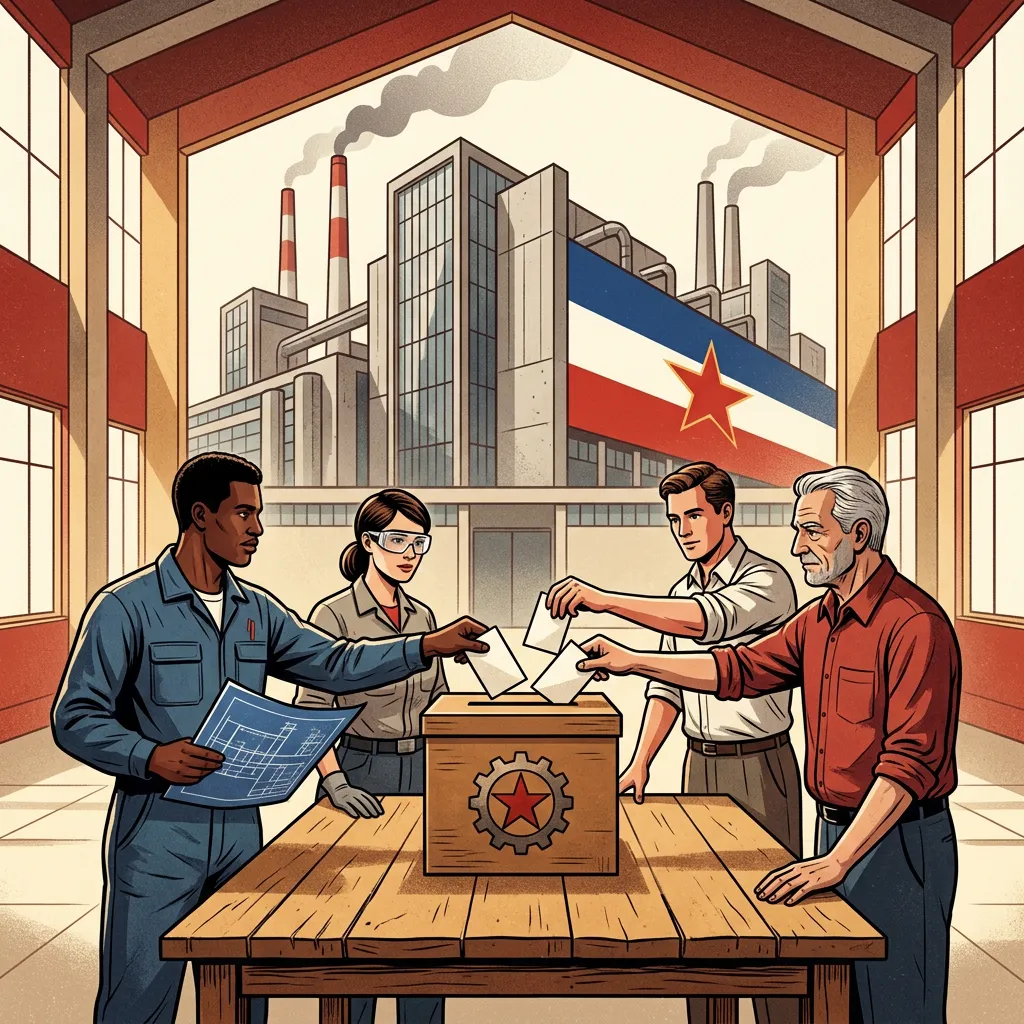
This was not a token participation scheme. Workers’ councils had genuine authority. They hired and fired managers. They approved annual plans. They decided how profits were reinvested. They were, in a meaningful sense, the owners of the enterprises they governed.
What Yugoslavia Built
A Market Socialist Economy. Unlike the Soviet Union’s centrally planned command economy, Yugoslavia operated a genuine market. Prices were largely determined by supply and demand. But unlike Western capitalism, the enterprises were not owned by private shareholders. They were socially owned — governed by their workers through elected councils. Market mechanisms without capitalist ownership. It was genuinely unprecedented.
Agricultural Cooperatives. Yugoslavia’s agricultural sector took a more complicated path than its industrial self-management story suggests. Between 1946 and 1953, Yugoslavia attempted its own Soviet-style forced collectivization — before abandoning it in the face of sustained peasant resistance. What emerged afterward was genuinely different from the Soviet model: voluntary General Agricultural Cooperatives that gave farmers real ownership stakes and the freedom to leave, rather than the permanent, coercive collective farms the USSR imposed. Unlike Soviet collectivization, Yugoslavia’s failure to force the issue never produced anything close to the catastrophic famines of Stalin’s USSR — but that was a product of Yugoslav peasants successfully resisting collectivization, not evidence that Yugoslavia never tried it.
A Non-Aligned Foreign Policy. Tito’s Yugoslavia became the founding member and leading voice of the Non-Aligned Movement — the coalition of nations that refused to take sides in the Cold War. This gave Yugoslavia access to both Western and Eastern markets, trade relationships, and technology.
Brotherhood and Unity. Yugoslavia was a multinational state — Serbs, Croats, Slovenes, Bosniaks, Macedonians, Montenegrins, and others living together under one federal structure. Tito’s governing philosophy of “Brotherhood and Unity” (Bratstvo i Jedinstvo) attempted to build a genuinely multi-ethnic socialist society.
The Numbers That Matter
- 🔗 GDP growth averaged over 6% annually throughout the 1960s — among the highest in the world. Economic reasons for the break-up of Yugoslavia — ScienceDirect
- Unemployment fell dramatically as worker-managed enterprises prioritized job retention
- Literacy rates rose from under 50% to over 90% between 1945 and 1980
- Life expectancy increased by over 20 years in the same period
- Yugoslavia became a middle-income country from a largely agrarian starting point in less than a generation
- Workers in self-managed enterprises reported significantly higher job satisfaction than comparable workers in both Soviet-style and Western capitalist enterprises
Want more history like this in your inbox?
New posts every week on cooperative economics, worker self-management, and the movements building a better world. No spam — ever.
Subscribe at solidarityecono.my →
The Contradictions
Political Repression. Yugoslavia was not a democracy. Tito’s Communist Party held a monopoly on political power. Opposition was suppressed. The secret police (UDBA) monitored dissidents — and, particularly from the 1960s–80s, assassinated dozens of émigré dissidents abroad. Economic democracy and political democracy did not go together in Yugoslavia. Workers could vote in their factory councils but not for opposition parties. That tension was never resolved.
However, political repression during the Cold War was not unique to Yugoslavia. Western democracies also employed extensive surveillance and covert operations against perceived political threats. Programs such as COINTELPRO in the United States infiltrated, disrupted, and illegally monitored civil rights, socialist, anti-war, and Black liberation organizations, while several Western European states were later implicated in unlawful counterterrorism operations, political surveillance, or collusion with paramilitary groups. The key difference was institutional: these actions occurred within multiparty democracies where elections continued, opposition parties remained legal, and many abuses were later exposed through courts, legislatures, or the press.
The Debt Crisis — Death by IMF. In the 1970s, Yugoslavia borrowed heavily from Western banks to fund investment and consumption — debt that grew from around $6 billion to over $21 billion by the 1980s. By 1981, the IMF stepped in, and what followed reads less like routine economic management than a deliberate dismantling. The IMF agreement stripped the federal government of independent access to credit from its own central bank, froze transfer payments to the republics, and forced a “stabilization” program of wage freezes, subsidy cuts, and mass liquidation of “unprofitable” state enterprises. Real wages collapsed by nearly 20% between 1979 and 1985. Unemployment surged past 1.3 million. By 1987, inflation had reached 167%.
The self-management system didn’t fail on its own terms — it was starved of the fiscal and monetary autonomy it needed to function, under conditions explicitly dictated from outside.
National Tensions. The “Brotherhood and Unity” slogan masked real and deepening tensions between Yugoslavia’s constituent nations. The economic decentralization of the self-management system inadvertently strengthened regional and national identities. After Tito’s death in 1980, these tensions intensified — ultimately contributing to Yugoslavia’s violent dissolution in the 1990s.
Enterprise Nationalism. Worker self-management created a perverse incentive: workers in profitable enterprises had reason to protect their own surplus rather than share it with workers in struggling enterprises. This “enterprise nationalism” undermined the solidarity that the system was supposed to build.
“It is the class that has enormous privileges and exclusive rights, hidden behind the collective ownership and the collective terminology, but which in essence very little differs from earlier ownership classes… the new class is only now arriving at full power. It is still developing… consolidating.” — Milovan Đilas, The New Class: An Analysis of the Communist System (1957)
What Titoism Proved — and What It Didn’t
What it proved:
- Worker self-management is economically viable — Yugoslavia’s growth record in the 1960s demolished the claim that worker ownership produces inefficiency
- Market socialism is possible — Yugoslavia proved you can have effective markets while the means of production remain under collective, non-private ownership rather than state or individual control
- Democratic workplace governance increases worker satisfaction — multiple studies found participation in Yugoslav self-managing councils was positively correlated with individual worker satisfaction, and workers themselves positively evaluated the councils’ ability to represent their interests
- Non-alignment is a viable geopolitical strategy — Yugoslavia successfully navigated the Cold War without becoming a satellite of either superpower
What it didn’t prove — or actively disproved:
You can’t have economic democracy without political democracy — not for long. Yugoslavia gave workers a real vote in their workplace while denying citizens a real vote on who governed the country. That split never held. The tension between the two was never resolved, and it was one of the pressures that eventually broke the system apart.
Self-management inside a factory doesn’t fix inequality between regions. Yugoslavia’s richer republics grew faster than its poorer ones under market self-management, and the gap widened rather than closed. Fairness between regions required deliberate redistribution — and Yugoslavia never built that strongly enough to hold the federation together.
Debt-financed growth eventually comes due. Yugoslavia borrowed heavily from Western banks in the 1970s to fund growth. That debt became the trigger for the economic collapse of the 1980s — IMF-imposed austerity, soaring inflation, and falling wages that helped tear the country apart.
The Connection to Today
The ideas that Tito and his theorists developed in the early 1950s are living ideas being put into practice right now — in the Mondragon federation in the Basque Country, in the USFWC building worker self-management infrastructure in the United States, in Emilia-Romagna’s 140-year practice of market socialism, and in the global solidarity economy that draws directly on the theoretical tradition that Titoism helped develop.
The Third Way that Tito pointed toward is still being built. Not by states, but by workers. Not from the top down, but from the bottom up. Not with one-party rule, but with genuine democratic ownership.
That path is still open.
Keep Going
- 🌐 Be part of it — solidarityecono.my
- 📋 Get involved — fill out our intake form
- 🛒 Shop at our Marketplace — solidarityecono.my
This is part of our History Bites series — bite-sized stories from the history of cooperative and solidarity economics. Want more? Join the Solidarity Economy platform and be part of building it.
Written by the Cooperative Codebase team — Aaron, Israel, and Jamie. Part of the Solidarity Economy Marketplace. Last updated: July 2026.
Comments