
History Bites · 8 min read
Mexico’s cooperative tradition didn’t begin with legislation. It began in the soil — in the communal land practices of indigenous communities that predate the Spanish conquest by centuries. From those ancient roots to the worker-owned textile cooperatives of Oaxaca and the energy cooperatives of Chiapas, Mexico has been running one of the world’s most diverse and resilient cooperative economies for longer than most nations have existed. This is that story.
20,000+ registered cooperatives in Mexico · 500 years of communal land tradition · 1 million+ Mexicans in cooperative enterprises today
The Roots: Before the Revolution
To understand Mexico’s cooperative economy you have to go back before the revolution — before the republic — all the way to the indigenous concept of communal stewardship of land and resources.
The ejido system — communal land held collectively by a village and worked by its members — is one of the oldest forms of cooperative economics in the Americas. It predates capitalism, colonialism, and the modern nation-state. When Spanish colonizers arrived in the 16th century, they found sophisticated systems of collective resource management already in place across Mesoamerica.
For further learning: Ejido — Wikipedia · Calpulli — Wikipedia · Ejido — Encyclopædia Britannica
The tequio tradition — communal labor contributed freely by community members for shared projects — is still practiced in indigenous communities across Oaxaca, Chiapas, and Guerrero today. These aren’t historical curiosities. They are living cooperative institutions.
For further learning: Tequio — Wikipedia
The Revolution and the Ejido: 1910–1940
The Mexican Revolution of 1910 was, at its heart, a fight over land. The revolutionary cry of “Tierra y Libertad” — Land and Liberty — was a demand for the restoration of communal land rights that had been stripped from indigenous and mestizo communities by the Díaz dictatorship.
The revolutionary leader Emiliano Zapata fought specifically for the restoration of the ejido system — collective land ownership returned to the communities that had always worked it. His Plan de Ayala of 1911 called for the expropriation of hacienda lands and their redistribution to cooperative communities.
When the revolution succeeded, the 1917 Constitution enshrined communal land rights for the first time in Mexican law. Article 27 established the legal framework for the ejido system — giving communities collective ownership of land that could not be sold or alienated.
Under President Lázaro Cárdenas (1934–1940), the ejido system reached its peak. Cárdenas redistributed approximately 18 million hectares of land to ejido communities — the largest land reform in Mexican history. He also nationalized the oil industry in 1938, creating Pemex as a state enterprise and declaring that Mexico’s oil reserves belonged to the nation — a parallel act of reclaiming a national resource from foreign private ownership, even if not structured as a cooperative in the way the ejidos were.
The Cooperative Law and Formal Organization
Mexico’s formal cooperative movement developed alongside the revolutionary land reform. Mexican cooperatives date back to 1873, with early legal regulation appearing in 1889, and the first General Law of Cooperative Societies was passed in 1927. After further legislation in 1933 and 1938 — the latter under Lázaro Cárdenas — Mexico’s cooperative framework was fully replaced by the current General Law of Cooperative Societies, enacted August 3, 1994, which provides the legal framework for cooperative enterprises across all sectors today.
Mexican law recognizes three types of cooperatives:
- Production cooperatives — worker-owned enterprises producing goods or services
- Consumer cooperatives — member-owned purchasing and distribution organizations
- Savings and loan cooperatives — member-owned credit institutions, similar to credit unions
The Agricultural Cooperatives: Feeding the Nation Together
Agriculture is where Mexico’s cooperative tradition runs deepest. At its peak, the ejido system covered roughly half of Mexico’s entire national territory and organized millions of farming families — more than 32,000 ejido communities — into collective production units. (Agriculture in Mexico — Wikipedia)
Coffee Cooperatives of Oaxaca and Chiapas. The coffee-growing highlands of Oaxaca and Chiapas are home to some of the most celebrated agricultural cooperatives in the world. Cooperativa Yeni Navan, ISMAM, and dozens of others have built farmer-owned supply chains that bypass exploitative middlemen and return premium prices directly to indigenous growers.
The Corn Cooperatives. Corn — maíz — is not just a crop in Mexico. It is a cultural foundation. Indigenous farming cooperatives across Oaxaca, Puebla, and Chiapas have been instrumental in preserving over 60 varieties of native corn against the pressure of industrial monoculture and genetically modified varieties. This is cooperative economics as cultural preservation.
Want more history like this in your inbox?
New posts every week on cooperative economics, solidarity economy history, and the movements building a better world. No spam — ever.
Subscribe at solidarityecono.my →
The Textile and Artisan Cooperatives
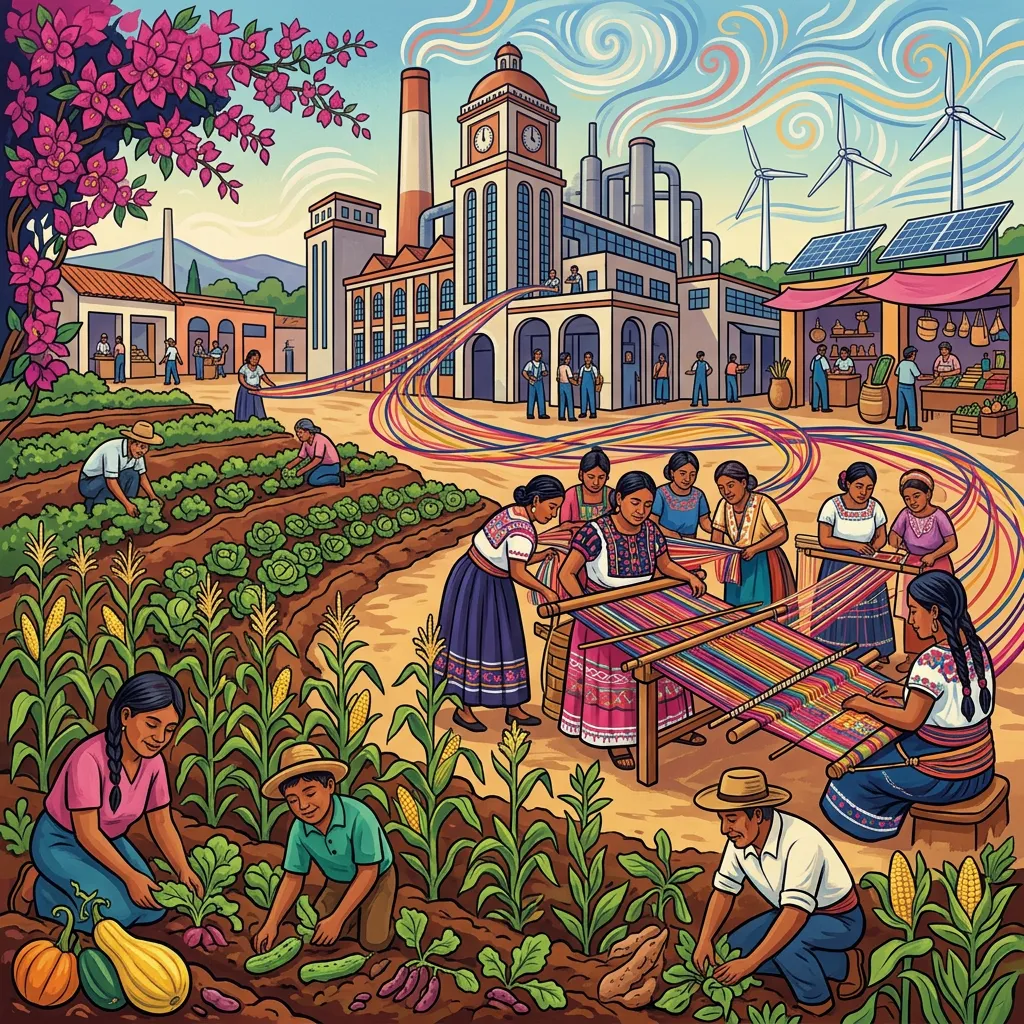
Indigenous artisan cooperatives — particularly in Oaxaca, Chiapas, and Michoacán — have organized weavers, potters, embroiderers, and craftspeople into collectively owned enterprises that:
- Own their own market access — selling directly to consumers and export buyers without exploitative intermediaries
- Control their own quality standards — protecting the authenticity and cultural value of traditional designs
- Share production costs — collectively owning looms, dyes, and workshop space
- Preserve indigenous knowledge — passing traditional techniques to the next generation as a cooperative cultural asset
The Mondragón of Mexico: Cooperativa Cruz Azul
Cruz Azul is a cement manufacturing cooperative founded in 1931 in Hidalgo that grew into one of the largest cement producers in Mexico. Its worker-owners — over 600 cooperative members — collectively own one of the most capital-intensive industrial enterprises in Latin America.
Cruz Azul built an entire city. The town of Ciudad Cooperativa Cruz Azul in Hidalgo was built by and for cooperative members — housing, schools, hospitals, sports facilities, and cultural centers all owned and governed collectively. It is Mexico’s answer to Mondragon.
The Energy Cooperatives: Chiapas and the Future
Can indigenous communities in Mexico co-own renewable energy projects?
Chiapas, Oaxaca, and Guerrero hold some of Mexico’s richest wind and solar resources — Oaxaca’s Isthmus of Tehuantepec alone contains more than half the country’s onshore wind potential. But most of the wind farms built there so far are privately owned by international developers, not the indigenous communities whose land hosts them, a mismatch that has fueled years of land-rights conflicts and stalled projects. That’s now driving a real push — from researchers, indigenous-rights groups, and community organizers — toward genuine co-ownership models, where local communities hold an equity stake in the renewable infrastructure built on their land, not just a lease payment or a promised job.
By organizing collectively to own wind farms and solar installations, indigenous communities are generating their own electricity, capturing the economic value of renewable resources on their own land, and building energy sovereignty as an extension of land sovereignty.
The Zapatistas: Autonomous Cooperative Communities
When the EZLN rose up in Chiapas on January 1, 1994 — the day NAFTA took effect — it was explicitly a revolt against the destruction of communal land rights.
The Zapatistas’ response was to build autonomous cooperative communities that operate outside the Mexican state entirely. These communities govern themselves democratically through community assemblies, own land collectively in the ejido tradition, run cooperative schools, clinics, and enterprises, and trade cooperatively with solidarity networks internationally.
The Zapatista autonomous communities are the most radical expression of cooperative economics in Mexico — a living experiment in what full economic and political democracy looks like in practice. (Read the full Zapatista story here)
Mexico’s cooperative tradition is old — older than the modern Mexican state itself, if you trace it back through the communal calpulli landholding of the Aztecs and the ejido system that grew from it. It runs from the communal milpa fields of Mesoamerica to Cooperativa La Cruz Azul, a worker-owned cement company in Hidalgo that’s operated continuously since 1934, to the weaving cooperatives of Oaxaca that Zapotec and Maya women organized to bypass exploitative middlemen. It has survived conquest, colonialism, and successive waves of privatization. That survival isn’t proof of any single ideology — but it is evidence that collective ownership has repeatedly reemerged as something Mexican communities choose, generation after generation, when they get the chance to organize their own economic lives.
The Challenges
- NAFTA and neoliberal reform — the 1994 reforms weakened ejido protections and exposed cooperative enterprises to intensified corporate competition
- Organized crime — in many regions, cooperative enterprises face extortion and violence from criminal organizations
- Access to capital — cooperative enterprises in Mexico have historically struggled to access financing on terms comparable to conventional businesses
- Legal complexity — Mexico’s cooperative law creates bureaucratic obstacles that discourage cooperative formation among informal workers
Keep Going
- 🌐 Be part of it — solidarityecono.my
- 📋 Get involved — fill out our intake form
- 🛒 Shop at our Marketplace — solidarityecono.my
This is part of our History Bites series — bite-sized stories from the history of cooperative and solidarity economics. Want more? Join the Solidarity Economy platform and be part of building it.
Written by the Cooperative Codebase team — Aaron, Israel, and Jamie. Part of the Solidarity Economy Marketplace. Last updated: July 2026.
Comments